

-
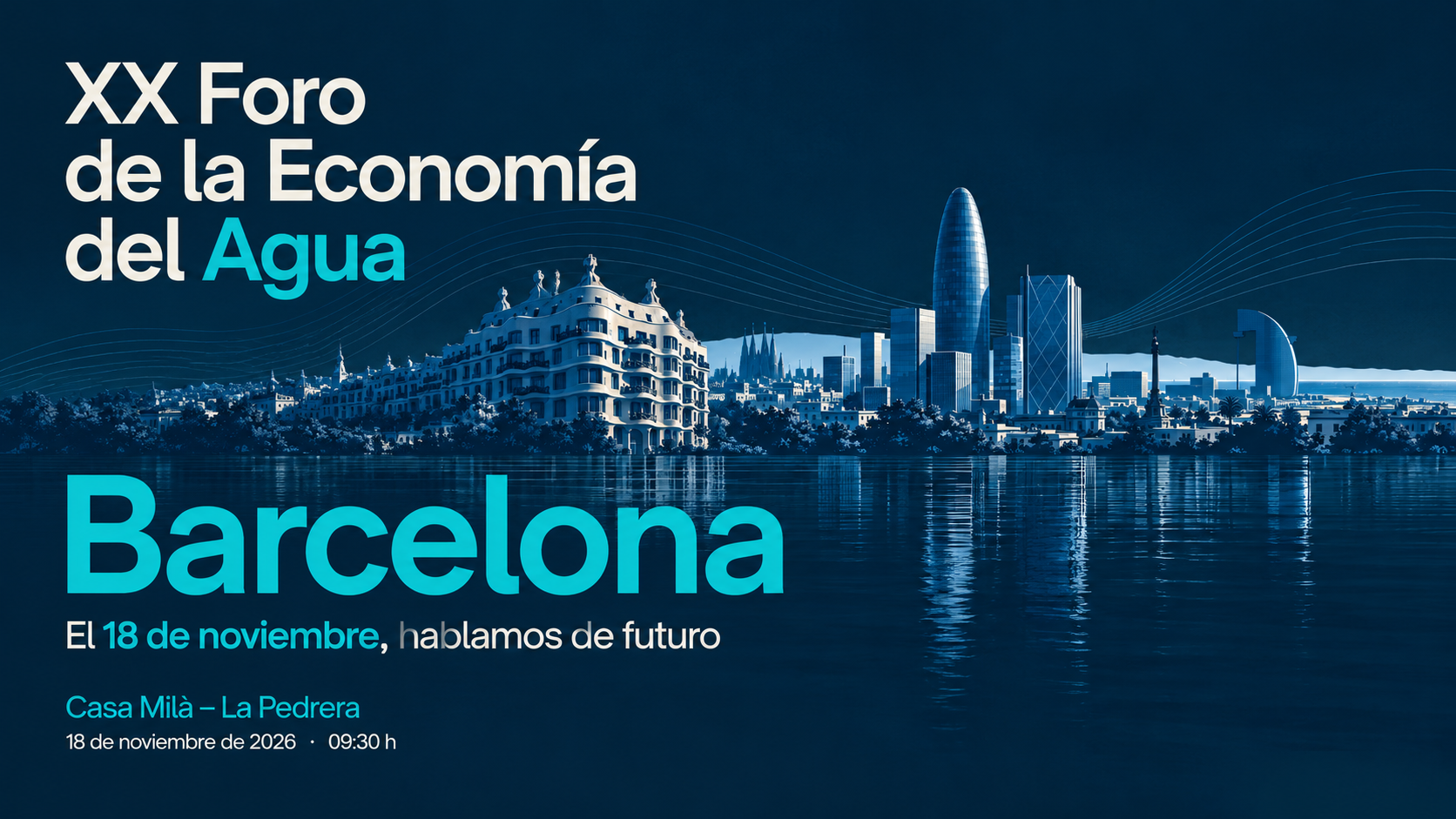
On 18 November, Barcelona will host the XX Foro de la Economía del Agua, with water geopolitics as the focus of the opening panel.
-
On the 21st-century geopolitical chessboard, water has ceased to be a purely environmental resource and has established itself as a strategic asset for national sovereignty and international stability.
-
“Water is not simply a scarce resource; unlike oil or gas, it has no substitute. It is a pillar of national sovereignty and institutional stability,” says Iván Redondo, CEO of Grupo Redondo and Chief of Staff to the President of the Government of Spain (2018–2021).
-
“Water is now a fundamental geopolitical factor in understanding the world we live in. It can be a source of conflict, but also of agreement and exploitation,” says Miguel Ángel Ballesteros, former Director of the Department of National Security (2018–2023).
-
A supply disruption can halt a plant just as effectively as a power outage, while a drought can simultaneously reduce the water available for production processes and hydroelectric generation.
-
Protecting water also means protecting the infrastructure that underpins the economy.
30 October 2026.
The major energy crises that have shaken the global economy have historically originated in oil fields, maritime straits or gas pipelines. However, on a planet shaped by climate change and geopolitical tensions, the next major disruption may not emerge from underground, but from a dried-up riverbed or compromised water infrastructure.
On the 21st-century geopolitical chessboard, water has ceased to be a purely environmental resource and has established itself as a strategic asset for national sovereignty and international stability. While gas and oil can be replaced through technological alternatives or alternative supply sources, the H₂O molecule has no substitute.
An irreplaceable asset in the global security architecture
At the upcoming XX Foro de la Economía del Agua, taking place on 18 November in Barcelona (Casa Milà, “La Pedrera”), two leading voices in security and institutional strategy will examine precisely how water-related risks are shaping global alliances and disputes. They will address these issues in the panel “The Security of the Future Is at Stake in Water: Risks, Threats and Geopolitics in an Increasingly Vulnerable World.”
Iván Redondo, CEO of Grupo Redondo and Chief of Staff to the President of the Government of Spain (2018–2021), highlights the irreplaceable nature of this asset:
“Water is not simply a scarce resource; unlike oil or gas, it has no substitute. It is a pillar of national sovereignty and institutional stability.”
This inelastic nature makes water resources a strategic factor that cuts across the boundaries of diplomacy, defence and global trade.
For his part, Brigadier General (Ret.) Miguel Ángel Ballesteros, former Director of the Department of National Security (2018–2023), recalls how water shapes the stability of entire regions:
“Water is now a fundamental geopolitical factor in understanding the world we live in. It can be a source of conflict, but also of agreement and exploitation.”
Ballesteros points to crucial historical and contemporary examples, from the Indus River — an essential source of life and a point of friction between Pakistan and India — to the Nile Basin and the regulation of aquifers in Palestine. He also highlights how, in the war in Ukraine, the Kakhovka Dam became a key military target from 2022 onwards, given its role in controlling the flow of water towards the Crimean Peninsula.
From the Strait of Hormuz to the industrial tap: water infrastructure in the crosshairs
Water vulnerability is not limited to rivers or shared aquifers; it extends to the physical infrastructure that treats and transports it. The military escalation in the Middle East has highlighted the extent to which these facilities can become instruments of strategic pressure.
In March 2026, Iran threatened to attack energy infrastructure and desalination plants in the Gulf if the United States targeted its power grid. Although the Islamic Revolutionary Guard Corps later appeared to withdraw the specific threat against desalination plants, the episode exposed the vulnerability of countries that depend on these facilities to secure their water supply.
The risks have gone beyond rhetoric. According to ACLED’s assessment of attacks on critical infrastructure in the Gulf, at least 172 attacks against non-military facilities in Gulf Cooperation Council countries were recorded between 28 February and 30 July 2026. The targets included power generation and desalination facilities, among them the Shuaiba plant in Kuwait.
The significance of these incidents extends beyond the physical damage. A desalination plant requires energy to produce water; power stations and many industrial facilities, in turn, need water to operate. When one of these infrastructures fails, the impact can spread throughout the wider system, jeopardising supply, production and economic activity.
This reality demonstrates that water security, national security and energy supply security form an inseparable network. Protecting water also means protecting the infrastructure that underpins the economy.
Water security is also at stake in industry
This geopolitical dimension has direct economic implications. Water availability determines food production, chemical manufacturing, steelmaking, component manufacturing and the operation of power plants. A supply disruption can halt a plant just as effectively as a power outage, while a drought can simultaneously reduce the water available for production processes and hydroelectric generation.
As we highlighted in our analysis of the water, industry and energy trilemma, these two resources are inseparable. And, as we explored when asking whether industry can drown in a glass of water, water-related risks can also affect energy costs, operational continuity and competitiveness.
For industrial energy management, this relationship calls for a broader perspective. Anticipating electricity and gas prices is not enough: it is also necessary to understand water availability, identify the most vulnerable processes and assess energy and water efficiency together. Water reuse, recirculation and supply diversification are no longer merely efficiency measures; they are becoming tools for resilience.
In a context of energy transition, new sources of demand and mounting pressure on resources, industrial security will also depend on how the infrastructure that enables economic activity is planned and protected.
Meeting in Barcelona
Water connects territories, economies and infrastructure. It can be a source of confrontation, but also an opportunity to establish lasting agreements. Ignoring its strategic dimension means underestimating both the risks of an increasingly vulnerable world and the opportunities for cooperation.
Understanding these dynamics is not merely a matter of national policy; it is a strategic requirement for industrial leaders. These issues will be discussed on 18 November at the XX Foro de la Economía del Agua, organised by the Foro de la Economía del Agua in collaboration with the Foro Industria y Energía and the Foro Mediterráneo Agua, Energía + Alimentación (FMAEA), at Casa Milà, “La Pedrera”, in Barcelona.
An essential gathering to analyse the risks, threats and opportunities associated with a resource that quietly shapes our industry’s competitiveness and the security of our future.