


-
Foro Industria y Energía and Opina 360 are expanding their overview of the Spanish electricity system by now incorporating demand data from the transmission grid.
-
The cross-analysis of the transmission and distribution maps shows that the electricity system cannot be analysed in silos: both the micro-grid (distribution network) and the macro-grid (transmission network) must be assessed.
-
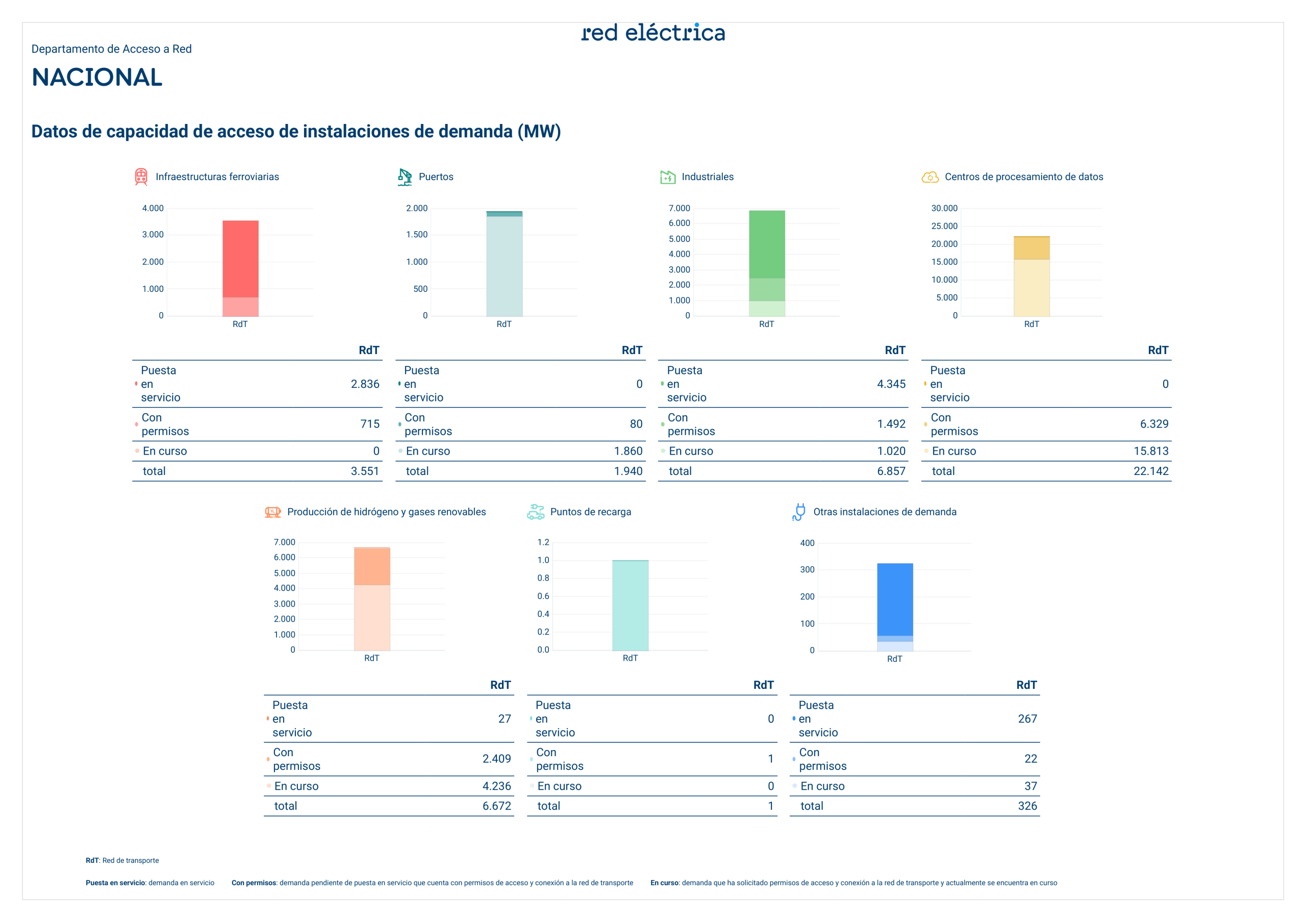
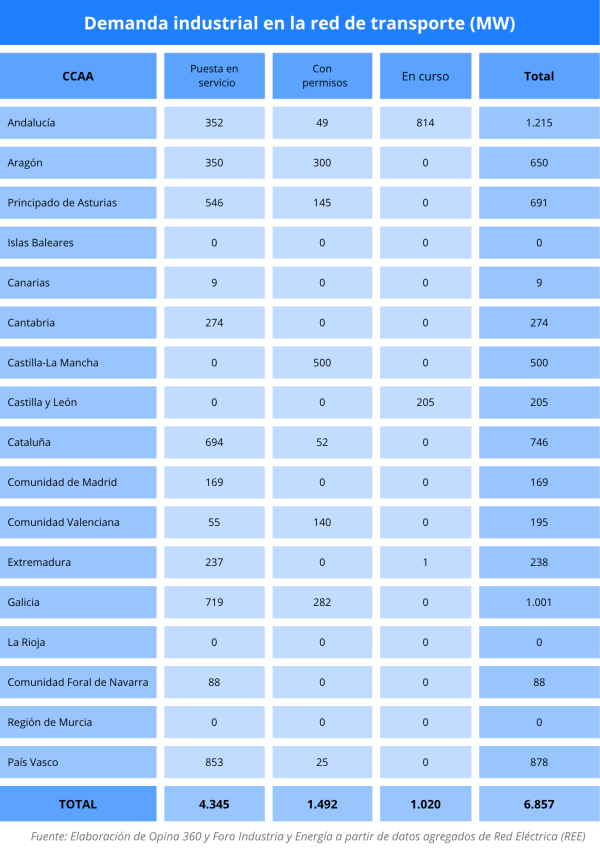
Industrial demand registered on the transmission grid amounts to 6,857 MW, of which 4,345 MW (63%) have already been commissioned.
-
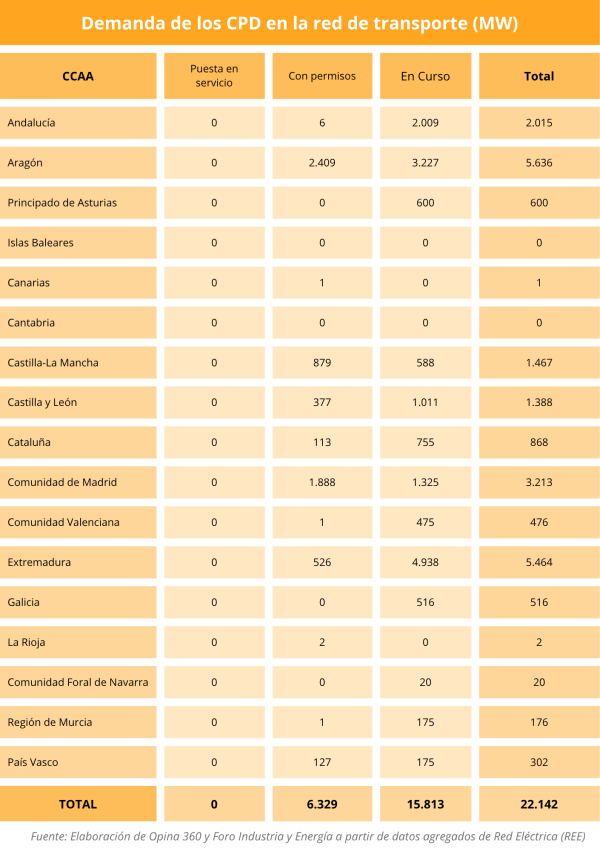
Data centres have accumulated a total of 22,142 MW requested on the transmission grid and currently have zero megawatts in service.
-
It will be crucial to monitor the actual conversion rate, observing how quickly megawatts currently under review are transformed into granted permits.
-
Grid access is no longer merely a technical or engineering issue; it has become the key determining factor for industrial policy, investment attraction and territorial competitiveness.
23 October 2026.
Foro Industria y Energía and Opina 360 are expanding their overview of the Spanish electricity system. After consolidating the monitoring of the distribution grid through the interactive map and the periodic analysis of its substations, the observatory is now incorporating demand data from the transmission grid. Based on the aggregated information, updated as of 30 September 2026 by Red Eléctrica on the status of access and connection applications, the new analysis examines this high-voltage infrastructure (220 kV or above), which hosts the country’s largest demand projects. This study raises questions about how the actual availability of connection capacity on this major grid will shape decision-making, investment plans and the future competitiveness of industry.
Industry leads installed capacity, but a potential territorial shift emerges
Focusing on industrial demand registered on the transmission grid, which reaches a total of 6,857 MW, the reality reveals a mature sector in which 4,345 MW (63%) have already been commissioned. This operational capacity is complemented by 1,492 MW with granted permits and 1,020 MW currently under review. No other demand category has a comparable volume in operation: railway infrastructure accounts for 2,836 MW in operation (out of a total of 3,551 MW requested), hydrogen and renewable gas production has only 27 MW in service (out of 6,672 MW requested), and data centres have not a single operational megawatt out of the 22,142 MW requested.
Geographically, the industrial capacity currently in service reflects the footprint of the traditional major industrial hubs. The Basque Country (853 MW), Galicia (719 MW), Catalonia (694 MW) and Asturias (546 MW) lead in industrial capacity connected to the high-voltage grid. However, the snapshot of the future is beginning to show dynamism elsewhere. Castilla-La Mancha currently has no industry connected to transmission lines, but has registered 500 MW with permits. Castilla y León, meanwhile, has 205 MW under review and no capacity in the other stages. The most striking case is Andalusia, which accounts for 814 MW of industrial capacity under review, representing 80% of the entire national volume in that phase.
This emerging reconfiguration raises numerous questions for energy planning and industrial policy: are we witnessing a gradual redesign of large-scale demand towards regions with greater renewable resource availability and land availability? Are these firm projects attracted by decarbonisation, or access applications at risk of expiring before they materialise? And if this shift consolidates, what will happen to the industrial dynamism of traditional hubs if available high-voltage capacity is not renewed or expanded at the pace required by the energy transition?
22,142 MW in the waiting room: the data centre phenomenon
The volume of applications registered by data centres represents one of the most striking phenomena on the transmission grid, far exceeding total industrial demand. Data centres have accumulated a total of 22,142 MW requested, split between 6,329 MW with granted permits and 15,813 MW currently under review. The territorial distribution of this digital appetite shows a marked concentration: in the applications-under-review phase, Extremadura (4,938 MW), Aragon (3,227 MW) and Andalusia (2,009 MW) account for the largest share of capacity being assessed. Looking at licences already granted, Aragon (2,409 MW), the Community of Madrid (1,888 MW) and Castilla-La Mancha (879 MW) lead the regional ranking.
Faced with this flood of applications on the transmission grid, the key question for the sector is what will happen to the applications currently under review and whether the distribution grid could serve as an alternative for projects that fail to obtain high-voltage authorisation. The data suggest that such a transfer is clearly unfeasible: available capacity across Spain’s distribution grid stands at 7,118.6 MW, a figure representing barely one third of what data centres are requesting on the transmission grid, with the added complication that this capacity must serve all types of consumers and economic sectors.
Against this backdrop of grid congestion, one alternative often proposed is for promoters of large technology projects to build their own substations. However, as we previously analysed at Foro Industria y Energía, this route is not an automatic panacea and faces significant technical and regulatory limitations.
All of this leaves a scenario full of unknowns for a category that currently has zero megawatts commissioned. What will ultimately happen to all these applications under review? Will they lapse due to lack of viability, or will they eventually relocate to other parts of the country? How many projects will actually materialise, and within what timeframes? Initiatives could be delayed, modified, relocated or ultimately not implemented — a range of possibilities that prompts deep reflection on how this uncertainty will affect the future development of the digital economy in Spain.
The need for an integrated view: the Basque Country as a case study between the macro-grid and micro-grid
The cross-analysis of the transmission and distribution maps shows that the electricity system cannot be analysed in silos. The lack of synchronisation between the transmission and distribution grids raises serious doubts about the capacity for expansion and decarbonisation of the productive fabric. The Basque Country has become the paradigm of this territorial contrast: on the one hand, it is the autonomous community with the highest industrial capacity commissioned on the transmission grid in Spain, with 853 MW in operation and a further 25 MW with granted permits. On the other hand, the picture of its distribution grid reveals a radically opposite scenario, with its 497 distribution substations completely saturated, registering zero megawatts (0 MW) of firm available capacity.
This asymmetry depicts a two-speed scenario that invites deep reflection on the region’s industrial future. While the Basque Country’s large industry directly connected to the high-voltage grid has its capacity and supply secured, immediate questions arise for the rest of the value chain: what happens to suppliers, the SME fabric and the electrification of thermal processes that inevitably depend on the distribution grid? How does this lack of headroom at medium voltage affect new industrial projects seeking to establish or expand in the region?
When the macro-grid and micro-grid fail to synchronise their pace and availability, the risk of a bottleneck for local competitiveness multiplies. For the energy transition to materialise in terms of jobs and investment, it is not enough for the megawatt to exist on paper or at major transmission nodes; it is essential to ensure the agility needed to deliver it capillarily to the factory gate.
Outlook: towards continuous monitoring of grid access
As this is the first instalment of this periodic analysis of the transmission grid, the current picture raises structural questions that will require constant monitoring in future updates. First, there is a lack of granularity regarding the actual number of applications: the public figures provided by the system operator are expressed in megawatts but do not specify how many applications lie behind each category, making it impossible to distinguish whether we are dealing with isolated megaprojects or a highly atomised fabric of requests.
Second, it will be crucial to monitor the system’s actual conversion rate, observing how quickly and to what extent megawatts currently “under review” are transformed into granted permits and, ultimately, into operational facilities commissioned.
Finally, the evolution of this “waiting room” of data centre projects will be strongly conditioned by the regulatory framework. The behaviour of applications will change as regulatory criteria on the expiry of applications, the requirement for financial guarantees and the organisation of access are applied. Tracking the transition between these states will be essential to distinguish mere expectations from demand that actually ends up being incorporated into the electricity system. What the data confirm from today is that grid access is no longer merely a technical or engineering issue; it has become the key determining factor for industrial policy, investment attraction and territorial competitiveness amid the energy transition.