

-
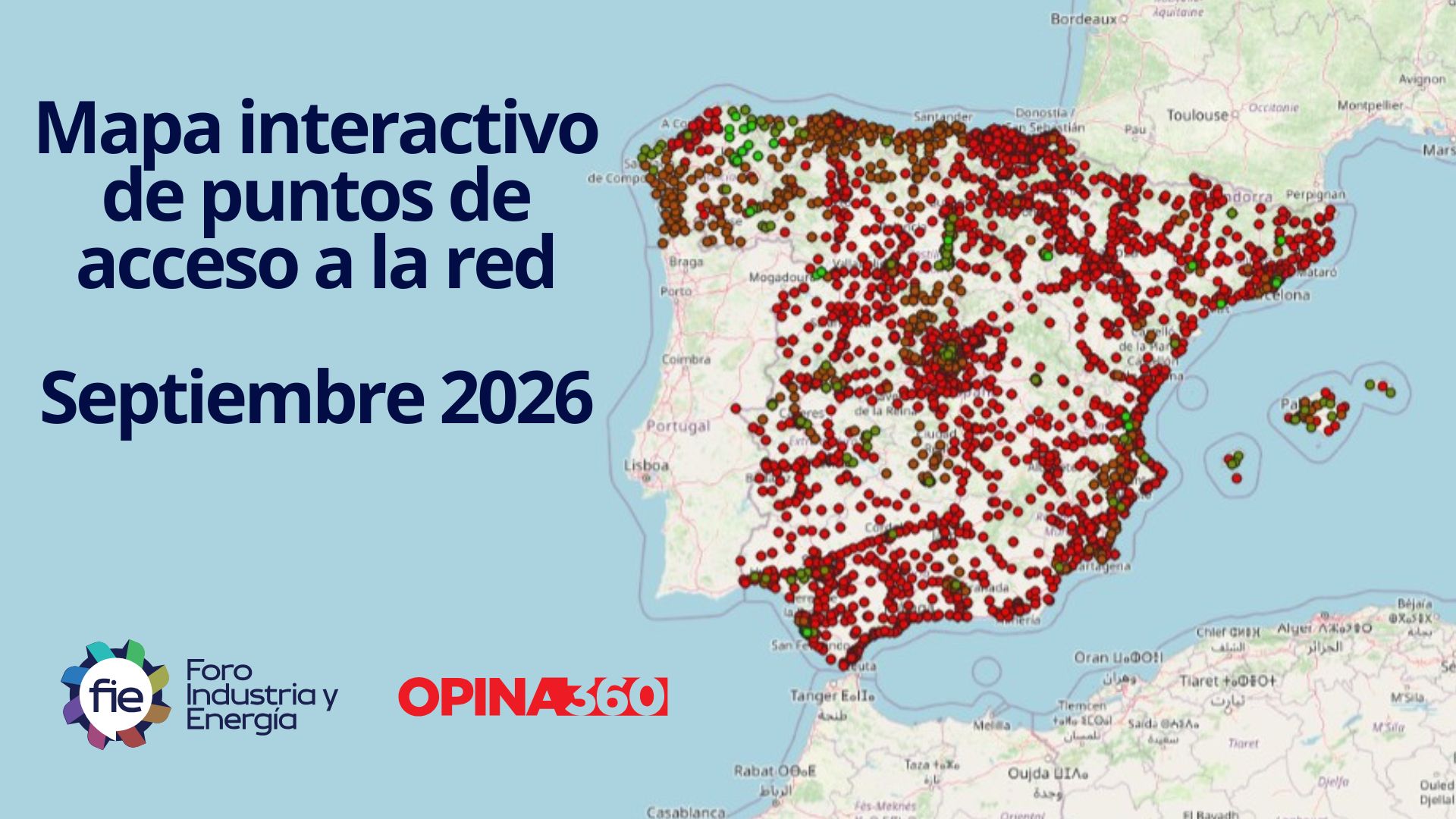
FIE presents updated map of access capacity to electrical substations.
-
86.5% of analyzed substations have no available access capacity, compared to 86.3% recorded in March.
-
The system has lost 282 MW net since March despite the new anti-hoarding regulations approved that same month by the Government.
-
The announcement of 193 new substations is timely, but its horizon is 2030, warns FIE.
-
More than a quarter of the megawatts that Spain reports as available carry some technical constraint, according to the analysis by FIE and Opina 360.
Madrid, 18 September 2026.
Foro Industria y Energía (FIE), in collaboration with Opina 360, presents an update of the national map of access capacity to electrical substations. The analysis of the new September 2026 map reveals that, out of the 6,127 operational substations across Spain, 5,301 (86.5%) are saturated and only 826 (13.5%) have available access capacity, compared to the 86.3% saturation rate recorded in March. The system has lost 282.2 net MW of available capacity, dropping from 7,400.8 to 7,118.6 MW. However, this aggregate figure masks significant movement of capacity across the grid: over six months, 1,258.6 MW of capacity were added in some areas, while 1,540.8 MW were occupied in others.
Regulations designed to free up space, with no visible effect yet
In March, the Government approved, through Article 11 of Royal Decree-Law 7/2026, a measure for Red Eléctrica to charge those who keep access capacity reserved without having started their activity, with the aim of freeing up capacity and curbing access hoarding. “It was reasonable to expect that the new regulations would have begun to free up capacity, but September’s data show precisely the opposite: the grid remains almost as saturated as six months ago, and in several regions it has even worsened,” says Juan Francisco Caro, director of Opina 360.
Grid saturation is not evenly distributed across the territory
The Basque Country (100% saturation and 0 MW available), Navarre (99.6% and 1.9 MW), and La Rioja (98.4% and 10.7 MW) show the highest saturation levels and, at the same time, the lowest available capacity. Eight provinces —Álava, Gipuzkoa, Bizkaia, Málaga, Albacete, Guadalajara, Salamanca, and Valladolid— have 100% of their substations saturated.
At the other end of the spectrum, Asturias (41.8%), the Balearic Islands (47.8%), and the Canary Islands (51.1%) have the lowest saturation levels. In terms of available capacity, Galicia (1,409.2 MW), Andalusia (941.8 MW), and Catalonia (832.1 MW) concentrate the largest volumes. Lugo is the province with the most available capacity, at 1,074.6 MW, although a significant portion of that capacity is subject to technical constraints.
Compared with March of this year, 10 regions have seen their saturation levels worsen, while 7 have improved. In terms of available capacity, 9 regions have lost MW while 8 have gained. The most striking case is Navarre, which has gone from 453.4 to just 1.9 MW available in six months.
The fine print: a quarter of “available” MW carry constraints
The work by FIE and Opina 360 analyzes, for the first time, the technical comments that distributors attach to their data, with a relevant finding: they affect only 5.6% of substations, but no less than 26.8% of the MW available in Spain. “Before taking a megawatt availability figure at face value, it is worth reading the fine print: in more than a quarter of those megawatts there is some constraint that should be verified before making investment decisions,” warns Isabel Núñez Rotta, director of FIE.
The most frequent constraint is the lack of physical space to expand the substation or connect a new bay. This circumstance appears in 234 substations and affects 530.8 MW of available capacity. It is followed by dependence on upstream transmission nodes, which affects another 243.3 MW. The analysis also identifies values pending update, such as that corresponding to the Boimente 400 node, which conditions much of the capacity attributed to Lugo, as well as limitations arising from the N-1 security criterion.
The analysis also identifies a potential avenue to increase available capacity. A total of 432 substations (7.1% of the total) are currently nodes without capacity that could eventually have it if the necessary reinforcements are carried out in the distribution networks.
More than €17 billion for grids, with a 2030 horizon
The Deputy Prime Minister, Sara Aagesen, announced on Wednesday in Congress an investment exceeding €17 billion in transmission grid planning through 2030, including 193 new substations. “This is one of the possible actions we have been calling for since we began analyzing the substation map in October last year,” says Albert Concepción, president of FIE. “But we need to be realistic: we are talking about planning through 2030, and companies that need to connect a project today cannot wait several years without that affecting their investment decisions.”