

-
If water sustains life, industry sustains a large part of our prosperity.
-
Water availability is one of the conditions that make industrial activity possible.
-
Both resources are closely interconnected: energy makes it possible to pump, treat and distribute water, while water is essential to numerous energy processes.
-
If water is essential to life, it is just as essential to the economy we know and, above all, to the one we want to build.
13 November 2026.
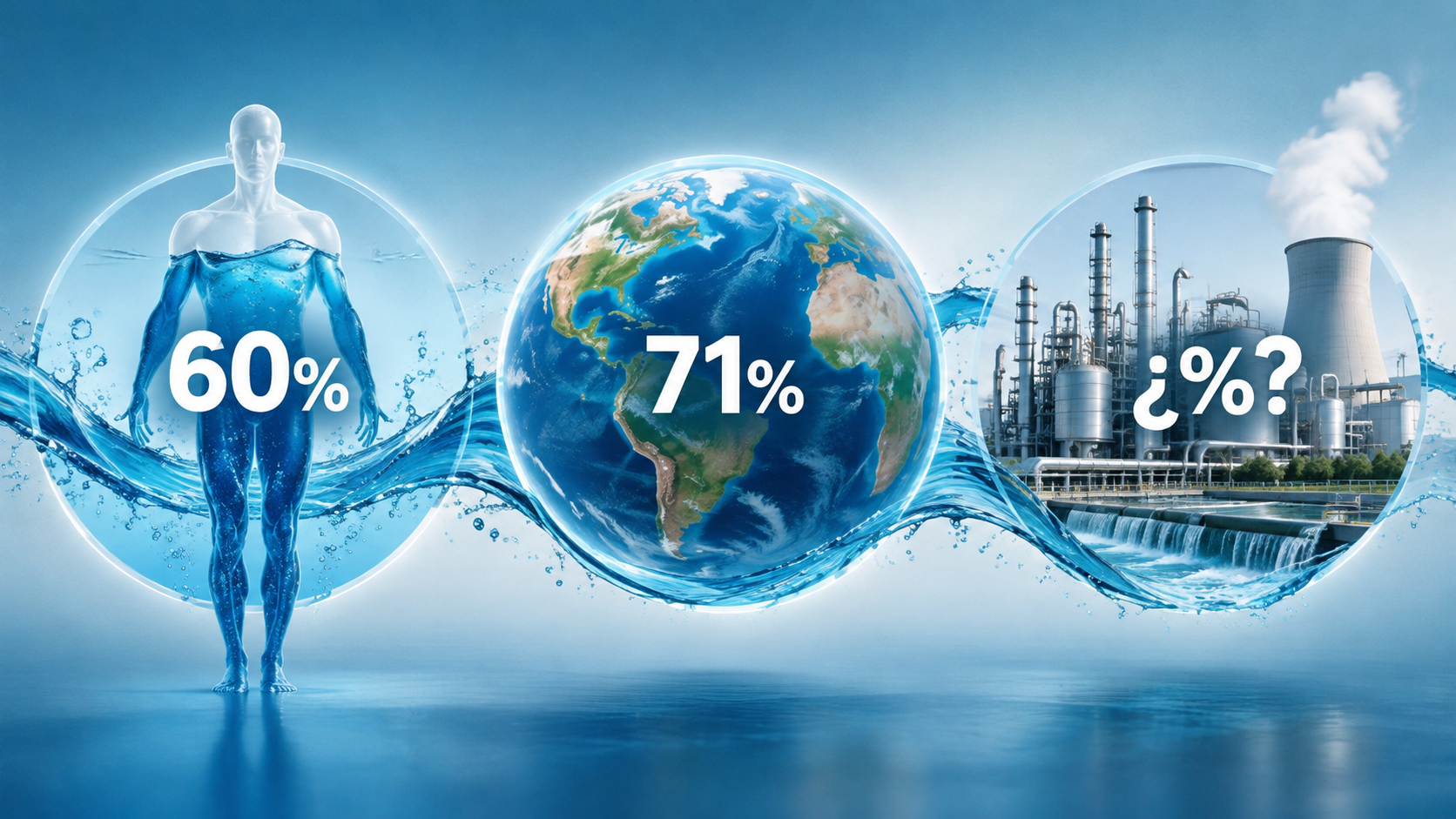
On average, an adult human body is made up of 60% water. In the brain and heart, that proportion is around 73%. And 71% of the Earth’s surface is covered by oceans. It is no coincidence that we call Earth the blue planet.
Water is present in virtually every process that makes life possible. It is not simply an ingredient, but the element that allows everything else to function: it regulates temperature, transports nutrients and enables countless biological reactions. When it is lacking, it is not just one function that suffers: the entire organism is put at risk.
There is another major system that also depends on its own vital elements: industry. It produces what we eat, what we wear, what keeps us healthy and much of what drives the economy. If water sustains life, industry sustains a large part of our prosperity. It is the engine that transforms raw materials into products, knowledge into innovation, and economic activity into jobs and well-being.
But what happens when we examine its composition? If we know the proportion of water our bodies need to function and the proportion that covers our planet, do we know how much this resource contributes to the functioning of industry?
The invisible fuel of the economic engine
We know how much water a human body contains and how much water there is on our planet. But what about industry? We are not talking only about the water recorded in consumption reports, but also about the water involved in industrial processes: the water used for cooling, cleaning, processing and transportation, or to maintain specific production conditions.
Its role varies from one sector to another, but there is one thing they all have in common: water availability is one of the conditions that make industrial activity possible. And yet, its importance does not always carry the same weight in business decisions as other essential resources.
Energy has long been incorporated into companies’ efficiency indicators, management dashboards and competitiveness strategies. Water, by contrast, still tends to attract attention when it becomes scarce, when it drives up costs or when it threatens to disrupt operations.
This difference deserves to be reconsidered. The energy transition is transforming industry’s resource requirements. Green hydrogen production, the development of new data centres, semiconductors and certain manufacturing processes are creating new demands for both energy and water. What happens to one of these resources increasingly affects the other.
At Foro Industria y Energía, we believe that the energy management of industry throughout the energy transition must also be understood in relation to water. Both resources are closely interconnected: energy makes it possible to pump, treat and distribute water, while water is essential to numerous energy generation and production processes. Understanding this interdependence is crucial to anticipating risks, improving efficiency and safeguarding industrial competitiveness.
A meeting in Barcelona to unravel the equation
With the aim of addressing these questions and analysing how water shapes both global security and the resilience of the productive sector, we will hold the XX Foro de la Economía del Agua on 18 November in Barcelona, at Casa Milà, “La Pedrera”.
The event is organised by Foro de la Economía del Agua in collaboration with Foro Industria y Energía and Foro Mediterráneo Agua, Energía + Alimentación (FMAEA). Experts in strategy, geopolitics and industrial management will discuss the risks and opportunities surrounding a resource for which there is no substitute.
Because understanding the weight of water in industry is not simply a matter of how much it consumes, but of the role its availability plays in the productive model we want to build. If water is essential to life, it is just as essential to the economy we know and, above all, to the one we want to build.