

-
Analysts Leonard Hyman and William Tilles warn that water scarcity is becoming an energy security issue.
-
Water risk travels through the power grid and reaches the entire energy system on which industry depends.
-
Water efficiency must be assessed alongside energy efficiency: measuring the megawatt-hour and the cubic metre together on the same dashboard.
-
The supply crises we have known were born in oil wells and gas pipelines. The next one could be born in a dry riverbed.
-
Drought strikes twice: it reduces the water available and undermines the electricity that depends on it.
October 16, 2026.
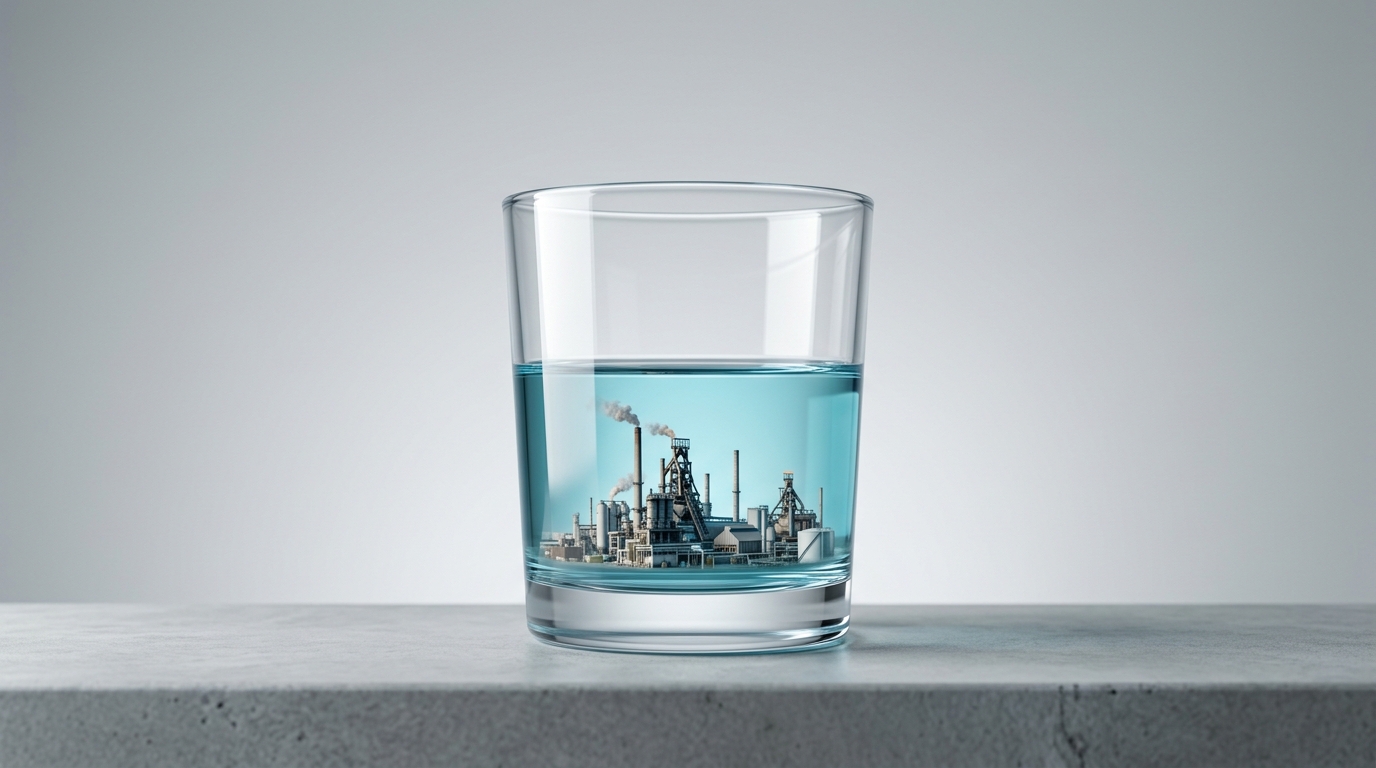
The expression “drowning in a glass of water” usually describes a minor problem, blown out of proportion by the concern it generates. In industry, the danger is the opposite: treating water as a minor issue, a background line item that does not deserve a seat at the table where energy strategy is decided. And the glass, year after year, is less full than we assume.
In our article on the water, industry and energy triad, we saw that the two resources are inseparable. Today we take it a step further: it is no longer just about recognising that dependence, but about asking what happens when it fails and what must change in industry’s energy management so that we are not caught too late.
Industry’s pulse at the pace of the flow
That the glass is emptying is not an impression. Water scarcity can no longer be considered a concern limited to exceptional episodes. According to the European Environment Agency, around 30% of the European Union’s land area experiences seasonal water scarcity every year, and projections point to growing pressure, especially in southern Europe.
Analysts Leonard Hyman and William Tilles recently warned that water scarcity is becoming an energy security issue. Their examples range from Lake Mead, at historic lows, with the Hoover Dam at its feet, to European rivers that do not carry enough flow to cool power plants or transport fuel by barge. To this they add extreme heat, which also reduces the capacity of power lines.
Drought thus strikes twice: it reduces the water available and undermines the electricity that depends on it. If we remember that, according to UNESCO, 49% of water consumption in Europe corresponds to industry, its role becomes clear: it is not a spectator of scarcity, but one of its main players.
A factory may have a guaranteed electricity supply, a full order book and all the machinery needed to produce. But if it does not have enough water to maintain its processes, all that capacity can be compromised. Production does not stop only because of a lack of energy. It can also stop because of a lack of water.
The energy drought also reaches the bill
Water scarcity does not stop at the factories that use it most: water risk travels through the power grid and reaches the entire energy system on which industry depends. When reservoirs fall, hydropower production suffers, and that gap has to be filled with other technologies, usually more expensive ones. Thus, a problem that begins in one river basin can end up affecting the electricity bill of a factory located elsewhere in the system. The result is a higher and more volatile energy cost for those who depend on electricity to produce. It is, at its core, a matter of competitiveness.
What we once called “energy drought” is thus consolidating itself as a direct toll on industrial profitability. H₂O is still GWh₂O, but only as long as there is H₂O.
Beware of managing water with traditional industrial indicators!
One of the main risks when assessing the true role of water in the industrial sector is applying indicators that may be useful in other settings but are not necessarily so in water management. Unlike most products, water defies the laws of supply and demand: raising tariffs will not make it rain, and its demand is completely inelastic: it is consumed practically the same regardless of price. Moreover, as Hyman and Tilles also remind us, historical data on water availability are no longer a reliable guide in an environment that has changed radically: past resources by no means guarantee current ones.
This volatility in water forecasts makes anticipation and coordination necessary.
Translated into industry’s energy management, this means putting water into risk analysis with the same seriousness as the price of gas or CO₂. Companies can identify their critical consumption, reduce losses, recirculate water in their processes and study the reuse of regenerated water, as well as subject the plant to water stress tests. But it is also necessary to coordinate water and energy policies, plan infrastructure according to resilience criteria and assess the cumulative effects of new demands on each territory.
Water efficiency, moreover, must be assessed alongside energy efficiency: measuring the megawatt-hour and the cubic metre together on the same dashboard. It is also worth checking whether the decarbonisation solutions we choose, from process electrification to hydrogen or intensive digitalisation, increase or reduce the facility’s thirst. Those “gigalitres of water” we once proposed as the third metric of the transition are beginning to seem less like a metaphor and more like a necessity.
A well-measured glass
The supply crises we have known were born in oil wells and gas pipelines. The next one could be born in a dry riverbed. Industry that reaches the next drought having measured, diversified and planned will not only suffer less: it will have an advantage over the one facing the problem for the first time with its plant shut down.
Drowning in a glass of water is an exaggeration. Running out of it is not. So the question is not whether industry can drown in a glass of water, but whether it can afford not to know how much water it has left.