

-
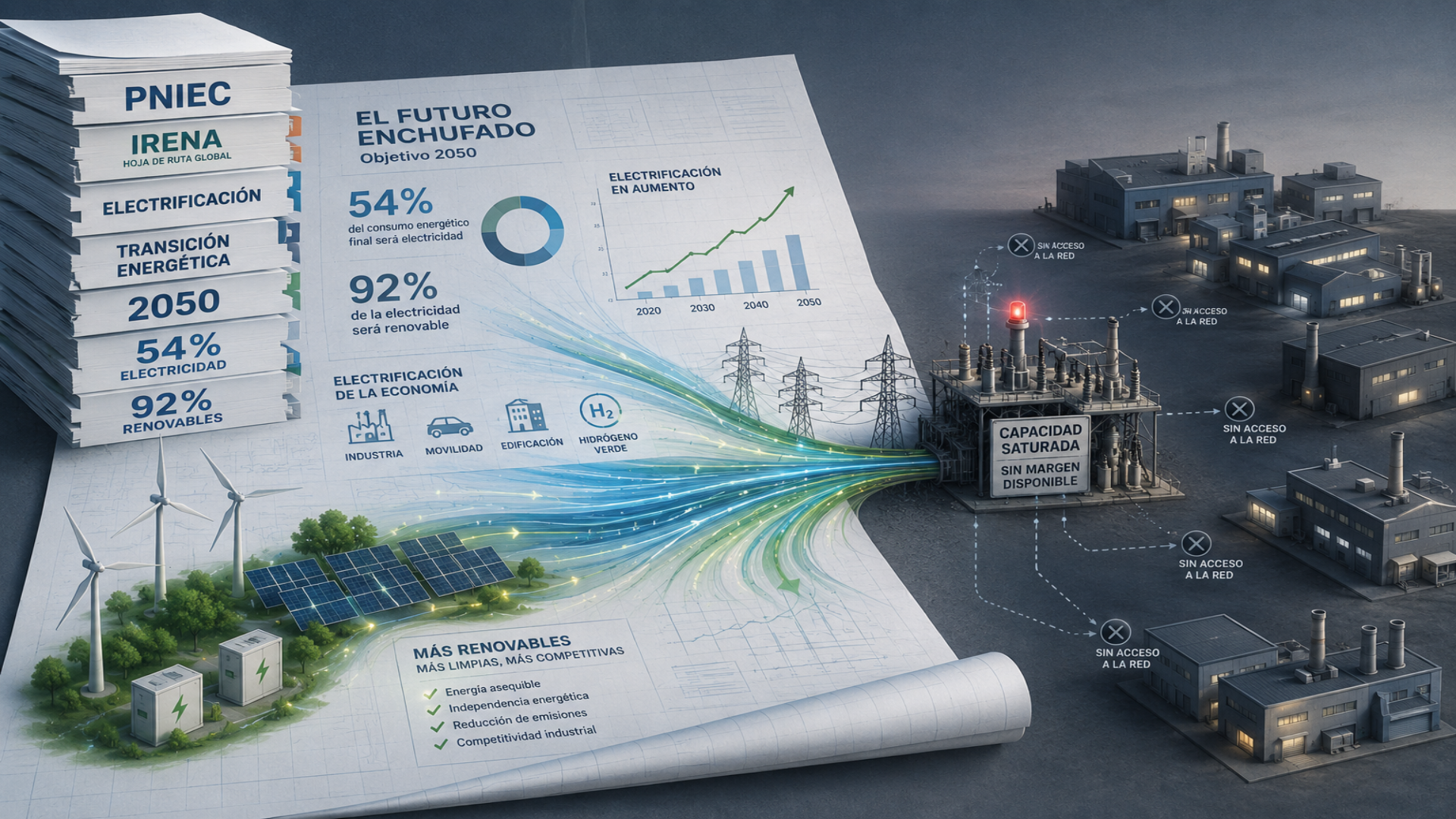
The future may be plugged in—but only if we first make it connectable.
-
According to IRENA, by 2050 more than half of global energy consumption will need to be electric, and almost all of that electricity will have to come from renewable sources.
-
Electrification does not advance in a vacuum: it requires substations, connections, planning, permits, and a grid capable of supporting new industrial demand.
-
The energy transition cannot rely solely on generation targets. It must incorporate a grid policy, an industrial policy, and a land-use and permitting policy that are aligned with one another.
-
The transition will not be completed through political voluntarism on paper; it will be consolidated by ensuring that every kilowatt of renewable energy produced can effectively reach the heart of our factories.
June 12, 2026.
The International Renewable Energy Agency (IRENA) has just updated its global roadmap with a scenario as ambitious as it is urgent to curb global warming: achieving by 2050 that 54% of global energy consumption is electrified and that 92% of that electricity comes from renewable sources. In Spain, the latest update of the National Integrated Energy and Climate Plan (PNIEC) aligns with this trend, projecting that electricity will rise from covering the current 25% to 35% of consumption by 2030, supported by a multi-billion investment mobilization.
However, the gap between statistical projections and the operational reality of the productive fabric opens up a profound debate. Are these targets truly feasible if the physical foundations on which they must rest—transmission and distribution networks—are suffering from structural bottlenecks that hinder competitiveness and industrial energy management during a full transformation process?
An article by Pedro Biurrun in Expansión rightly reminds us that renewable electrification is the backbone of the transition. But its most useful reading may be another: that the viability of this scenario will depend less on the ambition of the target than on our ability to build the infrastructure, regulatory framework, and business confidence that make it possible. In other words: the future may be plugged in—but only if we first make it connectable.
Climate utopia or intermediate milestone? The reality check of the 2030 and 2050 horizons
Assessing the feasibility of a scenario where more than half of the global economy is electrified requires confronting ambition with physical execution capacity. IRENA’s aspiration responds to the critical need not to exceed the 1.5°C threshold, a limit that climate reality itself has already temporarily surpassed. But environmental urgency is one thing, and the pace at which industrial systems can transform is quite another.
Renewable electrification of the economy is the right direction—necessary and already inevitable. But the destination is one thing, and the real speed at which we can reach it without undermining competitiveness, overloading the system, or leaving investments behind is another. For industrial energy management, transitioning to clean sources is not just a statement of intent, but an equation of costs, supply stability, and access availability.
Forcing renewable penetration rates without simultaneously resolving system firmness may compromise industrial supply security. This requires honesty: not everything will be electrifiable at the same pace, and accelerating without adequate grid support may reduce competitiveness compared to regions with more pragmatic transitions.
The real bottleneck: electricity does not travel alone
The real Gordian knot of this plan does not lie in generation capacity, but in the infrastructure required to transport it. IRENA rightly warns that grid infrastructure is becoming one of the key challenges of the transition, requiring massive expansion, storage, and flexibility.
Electrification does not advance in a vacuum: it requires substations, connections, planning, permits, and a grid capable of supporting new industrial demand. In Spain, this bottleneck is no longer a theoretical hypothesis, but a constraint shaping projects, timelines, and business decisions, as we have been highlighting from Foro Industria y Energía regarding grid access and capacity availability.
It is not enough to proclaim more electrification if industry cannot connect where it produces, expands, or decarbonizes. Nor does a purely statistical view of available capacity suffice if that capacity is located where there is no longer industrial land, or if the grid does not grow in line with real demand.
A grid at its limit: the map that contradicts official optimism
The current snapshot of the electricity transmission system is alarming and does not allow for complacency. As we pointed out last week in an open letter to Beatriz Corredor, president of Red Eléctrica, it is inaccurate to claim that no industry has been left without connection due to lack of infrastructure. The reality is that only one in four transmission substations in Spain (24.5%) has real capacity to meet demand.
This system saturation has led to critical situations, such as several companies having to renounce PERTE funding due to the material impossibility of connecting to the grid. The problem is compounded by inefficient distribution: in provinces such as Barcelona, available margins are concentrated in urban substations (such as Maragall or Vilanova), which are entirely unsuitable for the establishment of large industrial plants.
Meanwhile, in regions with high industrial attraction potential such as Andalusia, the grid is losing capacity at a rapid pace (921 MW in just five months), threatening to reduce connection margins to zero in the immediate future unless urgent expansions are undertaken.
Saturation without expansion: the challenge of making the future governable
The main challenge now is not to repeat that electrification is essential, but to turn it into a governable process. This means investing more and better in networks, accelerating permitting, organizing capacity planning, and preventing companies with mature projects from finding closed doors.
For this reason, the energy transition cannot rely solely on generation targets. It must incorporate a grid policy, an industrial policy, and a land-use and permitting policy that are aligned. Energy is not only a matter of supply; it is also a matter of location, timing, and confidence.
For Spain’s PNIEC target of reaching 35% electrification by 2030 to stop being a chimera, efforts must be redirected toward investment in networks. A saturated substation is a symptom of economic dynamism, but saturation without expansion is a direct path to loss of competitiveness. The transition will not be completed through political voluntarism on paper; it will be consolidated by ensuring that every kilowatt of renewable energy produced can effectively reach the heart of our factories.