

-
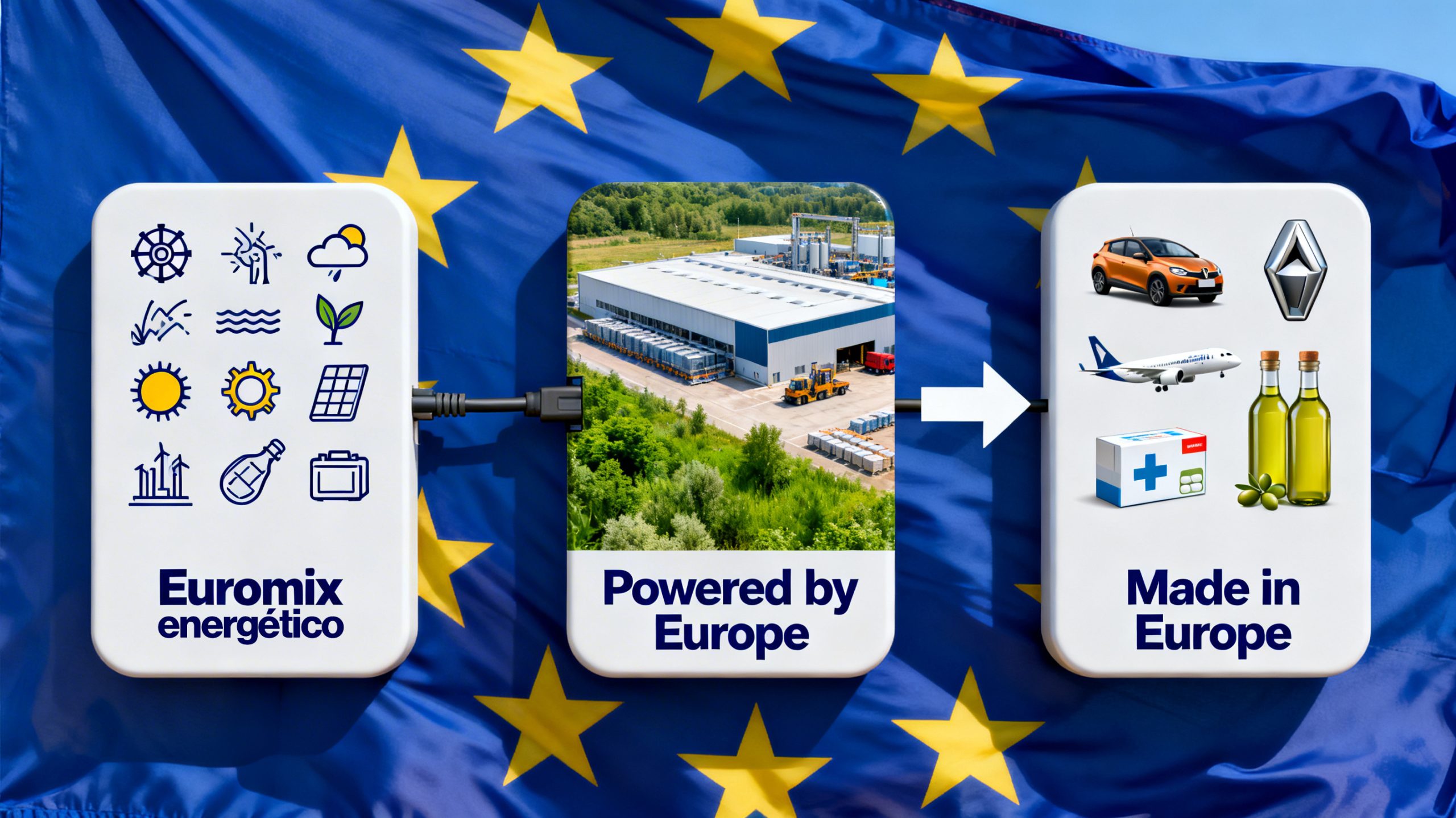
Without the right “Energy Euromix” there is no Powered by Europe. And without Powered by Europe there is no Made in Europe.
-
In a world where energy has stopped being a technical input and has become one of the main tools of foreign policy, the origin of the energy behind a product matters just as much as the country where it is manufactured.
-
Europe is betting on electrification as an industrial lever, but it has yet to answer what energy mix will sustain it.
-
The speech by Ursula von der Leyen at the Nuclear Energy Summit breaks the nuclear taboo and forces a rewrite of timelines.
-
Renewables, nuclear, storage: each technology will have its role, but no one yet knows exactly what that role will be.
March 13, 2026
Last week we argued that there will be no Made in Europe without a Powered by Europe. The thesis was simple, and with each passing day it becomes harder to refute: the “Made in Europe” label makes little sense if it does not rest on a sovereign energy base. In a world where energy has stopped being a technical input and has become one of the main instruments of foreign policy, the origin of the energy behind a product matters just as much as the country where it is manufactured.
This week we want to go a step further. The central question is whether Europe’s current energy mix can really sustain that Made in Europe. From that follow other questions: what should that mix look like? What concrete combination would allow industry to compete with structurally high electricity prices and an increasingly unpredictable geopolitical environment?
Let’s call it the “energy Euromix.” This is not just about which technologies appear in the picture, but about the specific combination that links our generation capacity with the final product: a robust electricity mix that powers our factories and ultimately gives life to the industrial renaissance of the continent. For Made in Europe to become a tangible reality rather than just a slogan, that question needs an answer.
The world for which we designed the transition no longer exists
For years, Europe built its energy roadmap around timelines and agreements that, in practice, have already become obsolete. Nuclear phase-out schedules agreed upon in several countries, the planned pace of renewable deployment, storage targets — all that framework was designed for a world of cheap and predictable energy that no longer exists.
First the Russian gas crisis, and later the instability in the Middle East, were not temporary disturbances but rather a reality check. In this new scenario, the timeline is no longer dictated by a climate roadmap but by the real capacity to deploy firm generation and grid infrastructure at the speed demanded by industrial demand.
Von der Leyen breaks the nuclear taboo
The most notable development this week comes from Paris. At the Nuclear Energy Summit, the President of the European Commission, Ursula von der Leyen, spoke words that would have been unthinkable just five years ago: turning away from nuclear energy was a strategic mistake for Europe. She did not mince words.
The Commission has said it plainly: Europe needs abundant and affordable electricity because the next industrial wave — AI, robotics, data centers — will be built on electrons, not barrels. This consolidates electrification as the backbone of the Euromix, but at the same time it disrupts many of the timelines we had taken for granted. In this new framework, nuclear returns to the center of the debate, not as nostalgia, but as necessity.
Alongside the speech, the Commission presented a strategy to deploy the first Small Modular Reactors (SMRs) in Europe before 2030, backed by €200 million in public guarantees and with a target of between 17 and 53 GW of additional nuclear capacity by 2050. The political signal is unequivocal: nuclear is not the past — it is part of the future.
From “or” to “and”: dogmas fall, questions emerge
The deeper change is not only rhetorical. The Euromix that Europe needs must be simultaneously clean, affordable, and secure — and no single technology can guarantee those three conditions on its own. This new scenario forces a reconsideration of several dogmas that once seemed immovable. The first: that renewables alone could cover the needs of a decarbonized European industry within the expected timelines. The second: that the gradual shutdown of nuclear power plants was an irreversible and unquestionable decision. The third: that transition timelines could remain insulated from geopolitical cycles.
The questions that emerge are more interesting than the dogmas that fall. What exact role will each technology — renewables, conventional nuclear, SMRs, storage, hydrogen — play in the Euromix of 2035 and of 2050? Can Europe build that mix while simultaneously prioritizing strategic autonomy, industrial affordability, and decarbonization? What are the real — not political — timelines for deploying the new generation of nuclear power?
Without Euromix there is no Powered by Europe. Without Powered by Europe there is no Made in Europe
The “energy Euromix” is not just another technical concept. It is the link connecting Europe’s industrial ambition with its real viability. Without an adequate energy mix, Powered by Europe is just a slogan. And without a solid Powered by Europe, Made in Europe is — as we already said — simply a label.
The logical sequence is clear: the energy Euromix powers Powered by Europe, and Powered by Europe makes Made in Europe possible. That is why the question of what energy mix Europe needs cannot remain a technical conversation reserved for sector experts. At its core, it is the question of what kind of industry — and what degree of strategic autonomy — Europe wants to have in the decades ahead.