

-
“When we talk about energy, we must do so in connection with the industrial ecosystem,” Jordi Hereu, Minister of Industry and Tourism.
-
“Industry is the spearhead in the defense of humanist values within Europe,” Jordi Hereu, Minister of Industry and Tourism.
-
“Industry, which had once been an instrument of confrontation, thus became a guarantor of peace and stability,” H.M. King Felipe VI.
-
“Without pride, you don’t win. Without humility, there is no possibility for improvement,” Jordi García Brustenga, Secretary of State for Industry.
-
“We generate some of the cheapest electricity in Europe thanks to renewable resources, yet the final price paid by industry is among the highest,” Mikel Jauregi, Minister of Industry of the Basque Government.
February 6, 2026
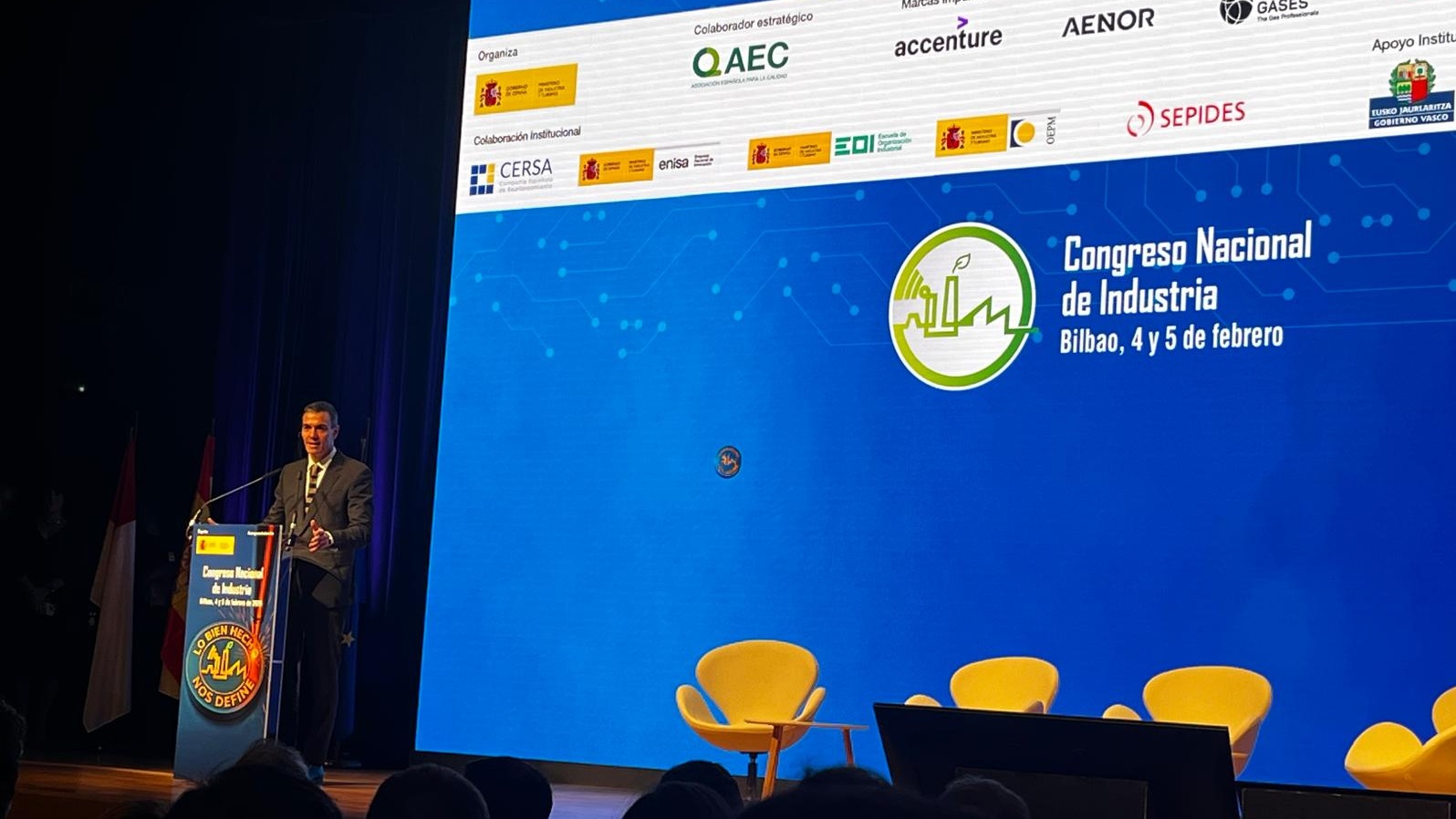
“Factory smoke is a memory of the past, but smoke-free factories are the certainty of the future.” With that sentence, Pedro Sánchez closed the National Industry Congress 2026 in Bilbao—an event that, over two days, placed industry at the center of the debate on the country’s economic and social future. “Doing things right defines us,” read the slogan. And that “doing things right” does not refer only to productive excellence, but to a way of understanding industry as a collective project, as a space where competitiveness, social cohesion, innovation, and values converge.
In this context, the Prime Minister recalled that “we have left behind industrial reconversion to embark on the industrial reconstruction of our country, if you’ll allow the play on words.” And yes, we allow it. We allow it because we are at a crucial moment in which industry can no longer be a reactive sector. In an uncertain geopolitical landscape, reconstruction necessarily implies strengthening strategic autonomy. “Smoke-free” industry goes beyond a mere environmental goal and becomes the foundation of real sovereignty—one that allows Spain and Europe to decide their own productive destiny without critical dependencies.
The DNA of the FIE: energy connected to the industrial ecosystem
Among all the speeches, one reflection by the Minister of Industry and Tourism, Jordi Hereu, felt strikingly familiar to us—almost as if he had read the founding charter of our organization. Recalling past conversations, Hereu stated: “We have held conferences where we talked about sustainable mobility, about the use of new energies… yes, but always connected to the industrial ecosystem.”
That seemingly simple phrase encapsulates the mission we set for ourselves long ago: energy management cannot be understood without industry, nor industry without energy management. It is an indivisible symbiosis. It was precisely under this premise—the need for both worlds to stop speaking different languages—that the Industry and Energy Forum was created, with the aim of reconciling industrial and energy policy. Hearing this message from the main podium of the congress confirms that the path we chose was the right one: talking about energy inevitably means talking about industrial competitiveness.
Industry as a guarantor of peace and humanism
The congress also served to raise the discussion beyond kilowatt-hours and balance sheets. Jordi Hereu stated that “Spain is betting on industry because industry is the spearhead in the defense of humanist values within Europe. And because industry is our best asset for defending Europe in the world.” This is not just about production or GDP. As the minister emphasized, industry means “growth in added value, innovation, exports, social and territorial cohesion,” but also something less tangible and no less decisive: social capital. “Ultimately, industry is people.”
This idea connects directly with a broad vision of industrial energy management—not as an isolated technical issue, but as a structural element that shapes employment, investment, territorial roots, and the ability to compete in an increasingly demanding global environment.
This humanist vision was reinforced by H.M. King Felipe VI, who, with the perspective afforded by four decades of European membership, took us back to the very origins of the Union. Recalling the ECSC (European Coal and Steel Community), the King underscored how “the founding fathers of a united Europe had the very clear idea of pooling nothing less than coal and steel production.” In other words, energy and heavy industry. What were once instruments of war became “guarantors of peace and stability.” This historical reflection is crucial to understanding the present moment: the energy transition is the new coal and steel. It is the bond that should unite us, not divide us.
The King proposed an “equation with multiple unknowns” that places European industry at its center: innovation, competitiveness, and reduced dependency. “Solving it will require more than ever the commitment of everyone,” he warned—a call to action that the FIE fully endorses, since for us that equation can only be solved if all links in the value chain are involved.
Doing things right as a country strategy
Jordi García Brustenga, Secretary of State for Industry, delved deeper into the congress slogan with a reflection that blended economic theory and popular culture. Referring to Michael Porter, he explained that companies—and countries—choose their strategy among price, quality, and differentiation. Then, many years later, he recalled with a laugh, Porter published another work saying that price is not a strategy. “That leaves us with two: quality and differentiation. Well, that’s where we already are.”
To illustrate his point, García Brustenga shared a peculiar joke about building frigates—which he admitted “isn’t funny at all,” but which contains a deep truth about Spanish idiosyncrasy. Faced with the Chinese builder who promises speed and low cost, the French one who boasts proprietary technology, and the German one who guarantees indestructible robustness, the Spaniard simply replies: “Mine will sail.”
“The Spaniard expresses, in the simplest possible way, pride, humility, and adaptability. Without pride, you don’t win. Without humility, there is no possibility for improvement,” he concluded.
This philosophy of doing things right, the Secretary of State argued, is not only about competitiveness, but also “about differentiation through democratic values and the welfare state. When we do things properly, we are defending our Spanish-European model.” A message that resonates strongly in an industrial sector facing the dual pressure of decarbonizing without losing competitiveness.
The energy paradox of industry
From a regional perspective, Mikel Jauregi, Minister of Industry, Energy Transition and Sustainability of the Basque Government, highlighted one of the major contradictions of Spain’s energy system. “We generate some of the cheapest electricity in Europe thanks to renewable resources,” he explained, “but the final price paid by industry is among the highest.”
A paradox reflected in striking figures: electricity costs up to 165% higher than in France, or 35% higher than in Germany for certain industrial sectors. The difference, Jauregi noted, lies not in the resource itself, but in regulatory design—regulated costs, tax burdens, and tools that the EU allows and that other countries apply more decisively to protect their electricity-intensive industries.
Electrification: a historic opportunity, an insufficient pace
At the panel “Energy sovereignty: towards a secure, efficient and sustainable future,” Gregorio Relaño, Director of Planning and Regulation at Iberdrola, painted a picture of both promise and concern regarding industrial electrification. “We are in the age of electricity, the age of electrification,” he stated confidently, citing Eurelectric projections that foresee electricity’s share of the energy mix rising from the current 20% to 50% in the coming decades.
However, according to Relaño, the figures reveal a worrying stagnation. Europe, Spain, and the United States hover around 22–23% electrification—a level that has barely changed over the last decade. To meet the 2030 targets—reaching 32–33%—electrification would need to grow by two percentage points per year for five years, “twice what China has chosen to do each year, because China has actually chosen,” he noted. The conclusion is clear: “The problem is not electrifying, but accelerating electrification.”
In this process, Relaño continued, industry is the main actor. The International Energy Agency estimates that at least 30% of growth in electricity demand will come from industrial electrification, with forecasts that electricity’s share in the industrial energy mix will rise from the current 30% to 45% within a decade.
But are infrastructures ready? While digitalization is advancing, the transmission grid is emerging as the major bottleneck. This is a critical issue that the FIE has closely monitored through its substation map—a tool that reveals a worrying reality: Spain’s power grid is losing available capacity and reaching high levels of saturation. Without robust and agile networks, industrial electrification will remain a pipe dream.
A transition with multiple pathways and homegrown technology
José Miguel Arzuaga, Technical Director at Alba Free Energy, introduced a crucial nuance into the debate: industrial decarbonization does not rely exclusively on electrification. He emphasized that other energy vectors also contribute to decarbonization, and that industry must use all the tools at its disposal.
Finally, Luis Pedrosa, Director of Energy, Strategy, Climate and Urban Transition at Tecnalia, struck at the heart of strategic autonomy: “We will not have industrial or energy sovereignty without technological sovereignty.” We need our own technology, value chains, and talent.
A congress that validates a founding intuition
The National Industry Congress 2026 made it clear that the intuition behind the creation of the Industry and Energy Forum—that industry and energy are inseparable—has gone from being a voice in the wilderness to becoming a consensus.
The message from Bilbao 2026 is clear. “Doing things right defines us,” yes. But in the 21st century, doing things right means intelligent energy management—one that resolves the price paradox, unlocks electricity networks, and understands, as Minister Hereu said, that any debate on energy is sterile if it is not connected, rooted, and placed at the service of the industrial ecosystem. The smoke-free factories evoked by the Prime Minister will only be a certainty of the future if we build the infrastructure, regulation, and collaboration that make them possible. Only then will our frigate not only sail, but lead the fleet.