

-
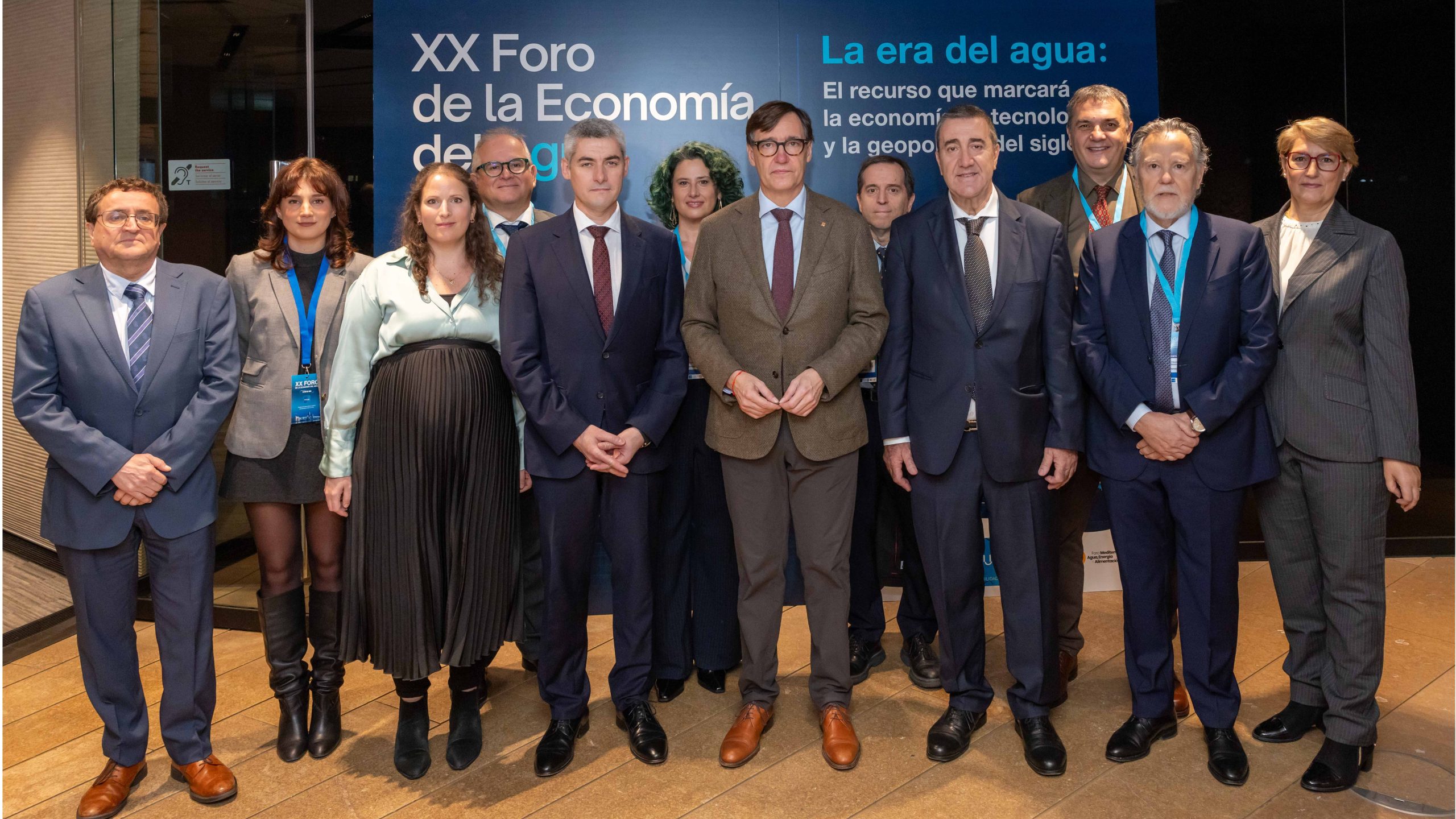
On 18 November, Barcelona hosted the 20th edition of the Foro de la Economía del Agua, an event held in collaboration with FIE that addressed the protection of critical infrastructure, climate risks and public-private collaboration.
-
“There can be no energy transition without water, no water security without energy, and no industry without both”, José Montilla.
-
“The water-energy nexus is our greatest lever for competitiveness”, José Montilla.
-
“This century will belong to those who know how to manage the inseparable water and energy nexus with intelligence, circularity and resilience”, José Montilla.
20 November 2026.
On 18 November, Barcelona hosted the 20th edition of the Foro de la Economía del Agua, an event organised by the Foro de la Economía del Agua in collaboration with the Foro Industria y Energía (FIE) and the Foro Mediterráneo Agua, Energía y Alimentación, attended by the President of the Generalitat, Salvador Illa. Building on the Barcelona Water Declaration, experts from the scientific, business and energy sectors focused on the protection of critical infrastructure, climate risks and the urgent need to strengthen public-private collaboration.
The event generated such a wealth of relevant analysis that, over the coming weeks, FIE will explore its main presentations in greater depth. Water availability is becoming an increasingly strategic factor shaping business decisions, competitiveness and economic development, a reality that Francisco Lombardo, president of Foro de la Economía del Agua, himself emphasized in this interview with Onda Cero following the conference.
We begin this series with the address by José Montilla Aguilera. Few voices offer such a comprehensive perspective: after nearly two decades as mayor of Cornellà de Llobregat, a predominantly industrial area, his time at the Ministry of Industry and as President of the Generalitat has given him first-hand insight into every level of government, as well as a deep understanding of industrial realities and the energy management of industry.
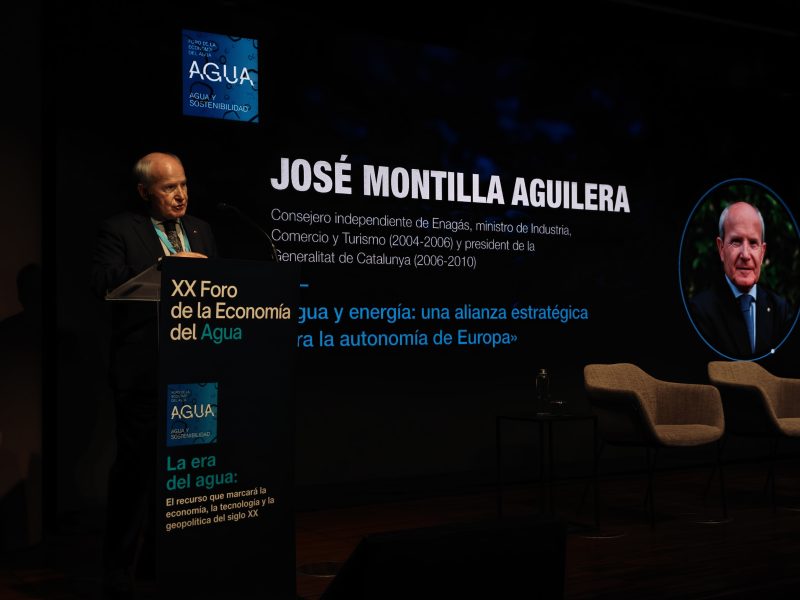
José Montilla Aguilera at the 20th Foro de la Economía del Agua
The end of a “dangerous fiction”
Montilla opened his address by pointing to a historical planning mistake: for decades, Europe developed its energy policy, water management and industrial competitiveness separately. Today, this siloed approach is unsustainable and constitutes, in his own words, a “dangerous fiction”.
The former minister summed it up with a powerful statement that sets the course for the energy management of industry: “There can be no energy transition without water, no water security without energy, and no industry without both”. Every megawatt generated, every molecule of green hydrogen produced through electrolysis, as well as the data centres and semiconductor gigafactories Europe hopes to attract, “ultimately depends on a constant and predictable supply of water”. Conversely, pumping, treating, desalinating or recycling water requires massive amounts of energy. Both resources already operate as a single system.
Managing the crisis: from the 2009 drought to the “new operating framework”
In a Mediterranean basin warming at twice the global average, prolonged droughts and extreme heatwaves “are no longer statistical or occasional anomalies; they are the new operating framework”. This reality puts the electricity system under pressure on two fronts: it reduces hydropower generation and compromises the cooling of thermal and nuclear power plants during demand peaks — as happened in France, which was forced to import electricity from Spain — while also requiring energy-intensive solutions such as desalination and advanced water reclamation.
At this point, Montilla looked back at one of the most challenging episodes of his time leading the Generalitat: the 2009 water crisis. “We were up to our necks in drought”, he recalled, highlighting the urgency of accelerating desalination plants, water reclamation facilities and inter-basin connections. These infrastructures have helped diversify supply sources, with water from unconventional resources now accounting for 30% of the water mix — a share that, according to forecasts, could reach 70% in the future.
Geopolitics and regulation: “bridging the gap between ambition and implementation”
The water-energy interdependence now directly affects industrial permitting and Europe’s strategic autonomy. Having witnessed, through the war in Ukraine and tensions in the Middle East, the cost of relying on third parties for energy supplies, Europe must recognise that water “is also the new strategic resource whose scarcity can destabilise entire supply chains”, including the processing of critical raw materials.
In response to those who see Europe’s regulatory density as a burden, Montilla argued that the water-energy nexus “is our greatest lever for competitiveness” — Europe accounts for 40% of global patents in water technologies — provided that the legislative rollout avoids “turning decarbonisation into deindustrialisation”. To achieve this, he called for “bridging the gap between regulatory ambition and implementation on the ground” through three commitments:
-
Integrated planning: “No national energy plan or strategic industrial project should be designed without a rigorous assessment of long-term water availability and hydrological conditions”.
-
Investment and public-private collaboration: mobilise European funds and private capital to modernise networks and advance zero-emission desalination technologies and industrial water reuse.
-
Smart digitalisation: turn every drop of water and every kilowatt into actionable data through sensors, digital twins and artificial intelligence, while protecting critical infrastructure against cyberattacks.
Montilla concluded with a strategic warning to the industrial sector: “The 20th century belonged to those who knew how and were able to secure access to fossil fuels. I am convinced that this century will belong to those who know how to manage the inseparable water and energy nexus with intelligence, circularity and resilience”. For industry, integrating both resources into its strategy is no longer a choice, but an essential condition for remaining competitive.