

-
“Using water is not the same as consuming water”, Pau Vila, CEO of LC Paper.
-
“Industry is not only a consumer of water; it is also part of the solution”, Joan Tristany, Managing Director of AMEC.
-
“Energy efficiency and decarbonisation are also tools for reducing our water footprint”, Carla Coloma, Global Sustainability Director at Fluidra.
-
“It is cheaper to invest than not to invest if we want to ensure profitability and durability”, Gabriel Blejman, Chief Innovation Officer at Aquapositive.
-
“Sustainability has to be a business case”, Carlos Velázquez, Sustainability & Service Senior Managing Director at Roca Group.
27 November 2026.
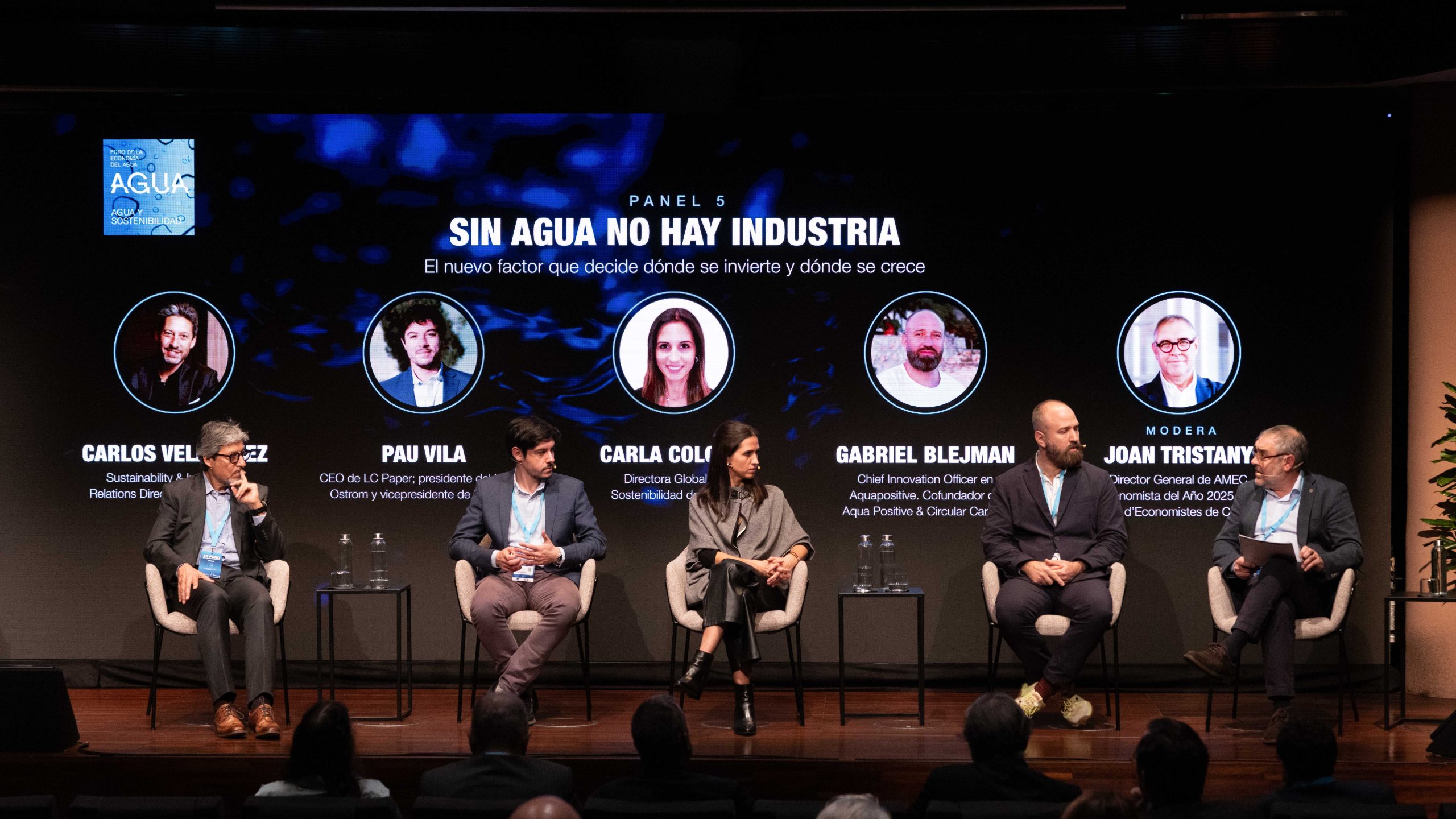
On 18 November, the Foro de la Economía del Agua devoted its fifth panel to an issue that is becoming increasingly decisive for productive activity: does Spain have enough water to keep growing? Under the title «No water, no industry. The new factor determining where investment goes and where growth happens», and moderated by Joan Tristany, Managing Director of AMEC and Economist of the Year 2025, awarded by the Col·legi d’Economistes de Catalunya, four representatives from Roca Group, LC Paper, Fluidra and Aquapositive shared how they are tackling this challenge from within their organisations.
Following José Montilla’s address, the FIE series gives a voice to those managing water on the factory floor.
Water becomes part of the investment equation
Joan Tristany recalled that industrial location has traditionally depended on factors such as energy costs, land, talent and infrastructure. Water availability and the ability to manage it efficiently must now be added to that list. This is not merely an environmental issue: access to water can determine where a factory is built, where production is expanded and which territories are best positioned to attract new investment.
Carlos Velázquez, Sustainability & Service Senior Managing Director at Roca Group, illustrated this with figures. The company, which operates 78 factories worldwide, has reduced its water consumption by 56% since 2018, bringing it down to 1.8 million cubic metres. To achieve this, it conducted audits to identify facilities located in areas of greater water stress and prioritise investment accordingly. The strategy also extends to its products: dual-flush systems have reduced toilet cistern water consumption from 12 litres to between 3.5 and 4 litres, while tap aerators deliver savings of 55%.
Water availability also shapes the company’s expansion plans. Velázquez explained that Roca is building a porcelain factory in Kazakhstan, a country facing medium-to-high water risk. The experience accumulated in efficiency, recovery and reuse makes it possible to approach the project with a target close to water net zero. «We have learned, and we dare to take on the challenge», he summed up. His conclusion was clear: «Sustainability has to be a business case».
Water and energy: two inseparable resources
Pau Vila, CEO of LC Paper, brought the perspective of the paper industry, traditionally a water-intensive sector. His approach is based on a fundamental distinction: «Using water is not the same as consuming water». In the manufacturing process, water acts as a vehicle for transforming cellulose fibres and recycled paper into a solid product. The pulp starts out containing 95–98% water, while the final paper contains less than 5%. The key lies in recovering and recirculating the resource, thereby reducing losses through evaporation.
The company has managed to bring its water consumption down to 1.3 cubic metres per tonne, compared with the more than six or seven cubic metres recorded across the sector at the beginning of the century. This reduction has a twofold effect: less evaporated water also means less energy is required for drying. «Water and energy are the same equation», Vila stated. He also advocated a comprehensive approach to sustainability, rather than focusing solely on favourable indicators: water footprint must be assessed alongside energy impact, emissions and transport.
Carla Coloma, Global Sustainability Director at Fluidra, further explored the relationship between these two resources. In the company’s case, its own operations account for just 0.15% of its total water footprint; a very significant share of its impact is associated with the energy consumed by its products during use. Energy efficiency and decarbonisation are therefore also tools for water management. Fluidra is working towards becoming water positive by 2030 and is developing the concept of the «positive pool», which aims to reduce dependence on external resources for both water and energy.
Beyond the factory gates
Gabriel Blejman, Chief Innovation Officer at Aquapositive, introduced an additional dimension: efficiency within facilities is essential, but it is not enough to guarantee a company’s water security. He highlighted the Jevons paradox: improvements in efficiency can ultimately lead to an increase in overall consumption if activity grows and pressure on the resource is not kept in check.
His proposal is to broaden the perspective and channel impact investment towards the river basins on which each business depends. Aquifer recharge, water regeneration and reducing losses in distribution networks are among the measures that can strengthen water availability. As he explained, water «is not fungible»: its value depends on its quantity, quality, accessibility and the territory in which it is found. Solutions must therefore be tailored to each river basin and to the needs of those who depend on it.
Investment also creates opportunities throughout the entire water cycle. Blejman recalled that around 90% of this investment currently comes from the public sector, compared with 10% from private sources, and highlighted the potential to mobilise corporate capital. «It is cheaper to invest than not to invest if we want to ensure profitability and durability», he argued.
Measuring, investing and taking action to remain competitive
At the end of the panel, participants shared specific recommendations for businesses. Coloma emphasised the need to analyse water-related risks, impacts and opportunities; Vila advocated external certifications as a way of setting targets and deadlines that go beyond internal goodwill; Velázquez called for every initiative to have a clear business case, while Blejman encouraged companies to first measure the impact of their activities and then contribute to addressing the shared challenges facing each river basin.
Tristany concluded with an idea that encapsulates the experience of all four companies: «Water cannot be treated in isolation». For the energy management of industry, the conclusion is equally relevant. Competitiveness will increasingly depend on the ability to integrate both resources into investment decisions, something we at FIE have long been advocating, to innovate in processes and products, and to contribute to the resilience of the territories in which businesses operate. Industry cannot simply adapt to water availability: it must also help secure it.