

-
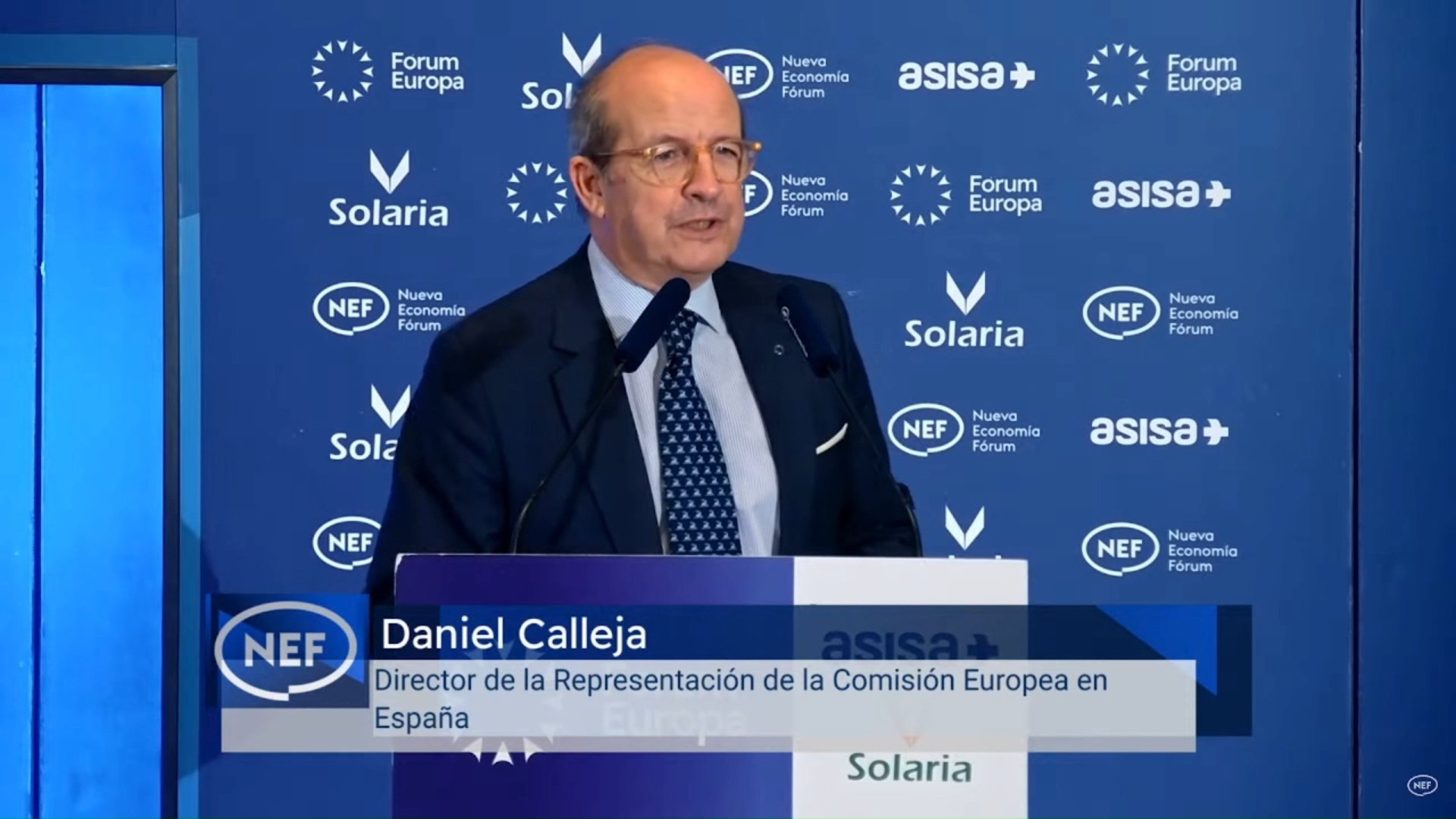
Daniel Calleja, newly appointed Director of the European Commission Representation in Spain, echoes Macron’s warning: “Europe is mortal” if it continues outsourcing its defense to the United States, depending on Russian fossil fuels, and offshoring its industry to China.
-
“Those who stand still will be left behind. Those who are not competitive will become dependent.” Daniel Calleja cites Von der Leyen to stress that European independence is no longer an ideological issue, but a condition for survival. Without competitive and secure energy, there can be no competitive industry.
-
Europe has permanently shut off the tap to Russian gas. By 2027 at the latest, the EU will have fully eliminated gas imports from Moscow, ending decades of energy dependence.
-
“Strategic autonomy is not built with speeches, but with cables, pipelines, interconnections and storage capacity. Sovereignty must be manufactured,” says the FIE.
-
Raquel Saiz, Head of Advocacy and Impact at Fundación Cotec: “We must understand that technology policy is also industrial policy.”
12 December 2025
The warning is simple but forceful: “Europe is mortal.” Emmanuel Macron’s phrase, recalled by Daniel Calleja during his address at Nueva Economía Fórum, captures the historic challenge facing the European Union. It is not merely a political metaphor: it is an economic and industrial diagnosis of a continent that cannot continue outsourcing its defense to the United States, depending on Russian fossil fuels, and offshoring its industry to China. This triple delegation—military, energy and industrial—defines the map of vulnerabilities that now threatens Europe’s position in the world.
Calleja, newly appointed Director of the European Commission Representation in Spain, placed the urgent need for strategic autonomy at the center of the debate. “We need a model change to strengthen our political, economic, industrial and military sovereignty. And we must do it in the next five years. We don’t have much time,” he warned.
His words mark the end of an era—the one that once held that “the best industrial policy is no industrial policy”—now clearly surpassed by an unavoidable reality: “The countries with the highest-quality jobs and the greatest prosperity are those with strong industry.” Because without competitive and secure energy, there can be no competitive industry. And without industry, there is no sovereignty. Europe must decide whether it wants to be a player or a spectator in a geopolitical arena where, as he noted quoting Von der Leyen, “those who stand still will be left behind. Those who are not competitive will become dependent.” European independence is no longer an ideological matter, but a condition for survival.
The end of Russian gas: closing an era of energy dependence
Calleja’s message comes at a decisive moment for European energy policy. On 3 December—just one week before his speech—the European Union reached a historic agreement to permanently end imports of Russian gas and to gradually phase out oil imports. The measure completes a process launched in 2022 with the REPowerEU plan, aimed at reducing energy dependence on Moscow after the invasion of Ukraine.
What began as an emergency response to a crisis now becomes a structural decision. By 2027 at the latest, the EU will have completely shut off Russian gas. The political agreement, signed by Parliament and Council, seals a paradigm shift: Europe seeks to secure its energy supply without accepting external pressures or geopolitical blackmail.
In the words of Commissioner Dan Jørgensen, “Europe has chosen energy security and independence. We will never again return to energy blackmail or economic exposure.” This step, symbolically powerful, marks the beginning of a Europe more aware of its vulnerabilities and more willing to invest in its own solutions.
But energy independence cannot simply be declared: it requires networks, technology, innovation and industrial capacity. Hence the significance of Calleja’s message, emphasizing that the European Commission will mobilize €3 billion to strengthen access to critical raw materials—graphite, cobalt, lithium—essential for electrification and the industry of the future. Without control over these materials, there can be no sustainable energy transition, nor real autonomy.
Connecting to withstand: networks as Europe’s backbone
The thread that stitches this new era is not only independence but interconnection. The European Commission has promoted 235 cross-border energy projects that embody what Calleja defended in his speech: “Unleashing the full potential of the single market by 2028 in capital, energy, services and telecommunications.” The figures speak for themselves: 113 electricity grid projects, 100 hydrogen and electrolyzer projects, 17 carbon transport infrastructure projects. Together, they aim to meet investment needs close to €1.5 trillion between 2024 and 2040.
These interconnections are not merely technical matters: they are political and economic instruments that ensure resilience in times of crisis and enable the sharing of both energy and stability. Because strategic autonomy is not built with speeches, but with cables, pipelines, interconnections and storage capacity. Ultimately, this physical architecture—reinforced by intelligent management systems—shapes a true European space of generation and consumption where energy is “accessible and affordable for both industry and households.”
Even the “reconnection” with the United Kingdom that Calleja mentioned follows this logic: “We want to link the European system with the British system… and move forward with electricity agreements that strengthen grid security.” Aligning emissions trading systems (ETS) and reinforcing interconnection agreements with London is not a technical gesture: it is a reminder that—even after Brexit—Europe’s energy security remains a common good.
From pilot to production: sovereignty that is manufactured
The path to strategic autonomy moves from political ambition to industrial execution. At the launch of the 2025 Spanish Innovation Yearbook by Innovaspain—dedicated precisely to strategic sovereignty—Raquel Saiz (Fundación Cotec) called for a more coherent and ambitious industrial and technology policy. “We must understand that technology policy is also industrial policy,” she noted.
At a time when the EU plans to increase investment in innovation by 83%, the major challenge, Saiz argues, is scaling up: moving from pilot project to prototype, and from prototype to industrial plant. In other words, transforming scientific advances into jobs, production and European profitability. Without this link between knowledge and production, autonomy will remain only an aspiration.
This vision aligns with Calleja’s message on the need for “European industrial champions.” Europe cannot aspire to lead the technological race if its industry lacks financial and regulatory tools to support growth. Fragmented venture capital markets or excessive bureaucracy risk sending promising projects across the Atlantic before they mature on European soil.
Europe is mortal… but it still has time to shape its future
Calleja’s warning is not a pessimistic diagnosis but a call to action. Europe may fade as a global actor if it does not act with the urgency this historic moment demands. But it can also be reborn when it recognizes its limits and chooses to overcome them. What emerges is a continent that understands its future will not be secured through diplomacy or market forces alone, but through its ability to manufacture, produce and innovate. Strategic autonomy is no longer an aspiration: it is the minimum requirement to preserve its voice in a rapidly transforming global economy.
The good news is that Europe seems to understand this. The end of Russian gas, massive investment in interconnections and the new industrial approach are steps in the right direction. The question is whether it can execute at the necessary speed. There is still time to decide what it wants to depend on, what it wants to produce and what role it wants to play. The next five years will tell. Because independence, as this week has shown, is not proclaimed: it is built. With industry, with energy, with unity.