


-
European industrial sovereignty faces its greatest challenge in decades amid a global landscape marked by geopolitical tensions, geoeconomic competition, and the energy transition. Europe must decide between reinventing its productive model or risking technological and competitive decline.
-
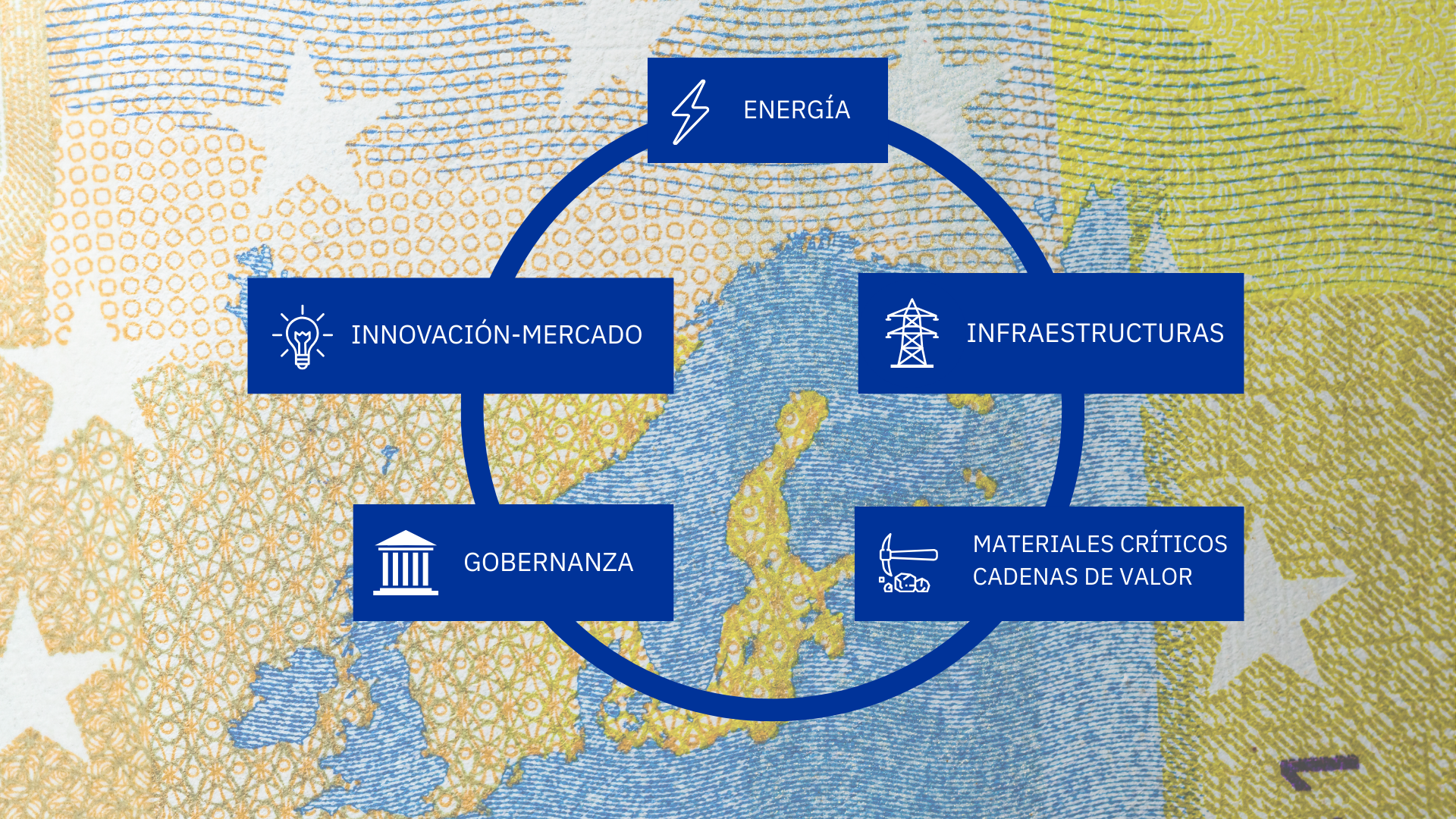
This analysis identifies five critical vectors shaping the continent’s industrial future: the gap between innovation and the market, energy dependence, scarcity of critical materials, infrastructure obsolescence, and institutional limitations in economic governance. Addressing these challenges will determine the viability of Europe’s industrial project.
By Héctor Santcovsky and Joan Ramon Morante
December 5, 2025
Europe’s industrial position is at a moment of structural redefinition. After decades in which the European model relied on a combination and balance of leadership in high-tech sectors based on scientific knowledge, a highly skilled workforce, states with robust social standards, and regulatory integration, the global landscape has shifted abruptly in a new geopolitical context.
The rising energy demand from Asian, African, and Latin American countries, alongside the war in Ukraine and the crisis in the Middle East, has accelerated the reconfiguration of energy and trade chains. The growing geoeconomic competition between the United States and China, the emergence of new, especially Asian, producing powers, and resource constraints have driven protectionist and fiscally aggressive industrial policies.
In this context, the EU has recognized that its traditional approach—based on knowledge, trade openness, globalization, environmental regulation, and social cohesion—is not a strong enough lever to maintain technological autonomy, productive competitiveness, and market position.
Recent assessments commissioned by the European Commission from Enrico Letta and Mario Draghi have helped define more precisely the critical bottlenecks of the current model. Both reports, although emphasizing different points, agree on the need to overcome the fragmentation of the internal market, the slow pace of decision-making—especially strategic decisions—and the lack of a common fiscal capacity capable of competing with the U.S. Inflation Reduction Act (mobilizing $369 billion) or Chinese industrial subsidies.
This article aims to explore the structural determinants shaping European industrial reorganization toward 2035.
1. Productivity and the Innovation-to-Market Gap
Europe maintains a high level of scientific and technological output, reflected in its contributions to high-impact journals, patent leadership, and the quality of research programs such as Horizon Europe (with a €95.5 billion budget for 2021–2027) aimed at strengthening European industrial competitiveness, as well as the creation of the European Institute of Technology (EIT) to transfer innovation from the lab to the market.
However, converting this knowledge into economic productivity has been severely affected by globalization, so that the chain from knowledge generation to market-ready products has been structurally and persistently deficient. OECD data show that total factor productivity growth in the EU has been consistently lower than in the United States since the early 2000s, particularly in technology-intensive sectors.
This gap is not due to a lack of talent or R&D investment but to structural factors, including insufficient harmonization between national planning and global market participation strategies.
First, Europe’s business landscape is dominated by micro, small, and medium-sized enterprises, which account for over 99% of all EU companies and contribute around 55% of value added. Yet their technological absorption capacity is limited by financial constraints, scale factors, and especially costs.
Second, European regulation, although ambitious in environmental and social terms, often lacks transnational harmonization, limiting the scalability of industrial solutions across the internal market. Regulation frequently restricts action without offering incentives or promoting objectives, unlike, for example, the U.S. Finally, administrative approval timelines for both industrial and energy projects are significantly longer than in other economic blocks, discouraging long-term private investment. The result is an innovation model that shines in the laboratory but fades in factories and companies.
Third, unlike the North American or Asian economic blocs, Europe’s decision-making structure is slowed by member states’ political bodies, with considerable difficulty in defining actions and executing the strategies outlined in consensus documents, exacerbating the gap between legislative and executive powers.
2. Energy as a Structural Determinant of Competitiveness
Access to abundant, low-cost energy is critical to maintaining competitiveness. The energy shock caused by global market dynamics, coupled with rising demand and the 2022 cut in Russian supplies, not only exposed Europe’s dependence on external sources but also increased energy costs and weakened European energy sovereignty.
Although wholesale gas and electricity prices have fallen from their historic peaks, average levels in the EU remain systematically higher than in the United States—thanks to access to unconventional gas—and China, where the energy mix remains heavily coal-dependent despite ongoing renewable energy expansion. In fact, electricity prices for industry in the EU are, on average, more than double those in the United States.
This differential affects energy-intensive sectors, sectors that need electrification, or sectors undergoing decarbonization, such as metallurgy, steel, semiconductors, petrochemicals, cement, fertilizers, paper, ceramics, advanced materials, or construction materials. In a global market where margins are tight and industrial location decisions are driven by cost and resource proximity, Europe has lost attractiveness.
Despite legislative ambition in the Green Deal and Industrial Decarbonization Strategy, progress remains generally slow. Renewable deployment is delayed, administrative bottlenecks persist, pan-European planning is lacking, grid capacities are limited, cross-border interconnections are insufficient, and large-scale storage infrastructure is absent, preventing the energy transition from becoming a vector of competitiveness. As the Draghi report noted, European energy policy must move beyond an aggregation of national decisions to become a common infrastructure for the European project.
3. Resources, Critical Materials, Value Chains, and Competitiveness
Industrial production is directly linked to natural resource availability. These resources are increasingly scarce, and the list of critical materials has grown in recent decades, driven by the energy transition, industrial digitalization, and decarbonization demands. Strategic sectors such as electric mobility, stationary energy storage, power electronics, power grids, renewable energy generation, CO₂ reduction catalysts and reactors, and green hydrogen production depend on a limited number of metals and minerals—lithium, cobalt, nickel, rare earths, graphite, silver, ruthenium, platinum—whose extraction, refining, and processing are highly geographically concentrated.
Europe lacks significant reserves and, within a globalized economy, has outsourced many processes to countries with more resources or lower labor costs. Additionally, Europe has a marginal presence in intermediate stages of value chains and depends almost entirely on external suppliers, mainly China, which controls over 60% of global rare earth processing and more than 80% of battery processing. The Critical Raw Materials Act, adopted in 2024, represents an important step toward mitigating this vulnerability by setting quantitative targets for production, processing, and recycling in Europe. By 2030, EU lithium demand is expected to be 18 times higher than in 2020, mainly driven by electric mobility.
However, implementation is hindered by member state fragmentation, local resistance to mining projects, and insufficient investment in refining technologies without a clear support program. Recycling, though promising on paper, cannot compensate in the short term for the lack of extraction and processing capacity, as it also requires time and investment. Without guaranteed access to critical materials, European reindustrialization risks remaining a political proclamation without material support.
4. Infrastructure: the New Bottleneck
Historically, European industrial policy debates have focused on financing and regulation, relegating infrastructure. Yet 21st-century economies demand integrated electricity grids capable of handling high levels of renewable generation, seamless cross-border interconnections, distributed storage systems, resilient logistics corridors, and state-of-the-art data centers powered by clean energy. Europe largely operates with 20th-century infrastructure designed for centralized national models, with low renewable penetration and limited digital demand.
Compute-intensive industries driven by generative AI, life sciences, industrial simulation, or smart logistics will require exponential growth in digital capacity, increasing energy demand. Electrification replacing fossil fuel use further adds to this demand.
Decarbonizing industries with hard-to-abate CO₂ emissions also requires massive energy input for capture and conversion processes. For example, electricity consumption in EU data centers is projected to increase by 28% by 2030.
Without rapid grid modernization and coordinated European planning with detailed roadmaps, technological sovereignty will remain rhetorical. Infrastructure is not a passive support but an active factor for competitiveness and autonomy.
5. European Economic Governance: Instruments, Limits, and the Need for Scale
The fifth, and perhaps most decisive, vector is institutional. EU industrial competitiveness policy is implemented through a multiplicity of instruments—IPCEI, InvestEU, Horizon Europe, Innovation Fund, Global Gateway, EIT—which, though well designed sectorally, operate in an environment of regulatory fragmentation and fiscal asymmetry. National aid systems create competitive distortions between member states, hindering the creation of European industrial champions and favoring internal competition over strategic cooperation. In 2022, Germany and France alone accounted for roughly 77% of state aid notified in the EU, accentuating asymmetries.
The Letta report highlights that regulatory fragmentation effectively reduces internal market scale, especially in sensitive sectors such as energy, mobility, or clean technologies. Draghi stresses that the EU lacks a true common fiscal capacity to respond quickly to strategic industrial investments. This situation echoes Karl Polanyi’s warning that “market deregulation is usually followed by periods of profound social and institutional transformation in which society protects itself,” a process Europe must manage collectively.
Current governance—characterized by slow processes, overlapping competencies, and weak coordination—is incompatible with the speed required by energy and digital transitions. Without a profound reform of institutional architecture—including accelerated decision-making, effective execution, common financing, and regulatory harmonization—any reindustrialization effort will be constantly eroded by bureaucratic inertia and national divergence.
Toward a New European Industrial Paradigm
The five analyzed vectors are not a catalogue of weaknesses but structural constraints that any realistic reindustrialization strategy must address. Europe’s challenge is not to revive past manufacturing but to design a legislative and executive system capable of absorbing emerging technologies, producing competitive energy, securing access to critical resources and materials, and executing continental-scale decisions with convergent actions.
First, implement an integrated European energy framework, with common planning, reinforced interconnections, and storage systems that make renewable electricity a competitive industrial vector. Establishing an European Energy Authority with executive capacity, its own fund, stabilized industrial prices through long-term contracts, and cross-border energy corridors with binding regional targets would be crucial.
Second, develop an industrial policy focused on high-multiplier sectors, combining financial instruments, centralized innovative public contracts, public-private collaboration incentives, and R&D support. Complementary actions should include a pan-European smart grid, 100% renewable data centers, and integrated digital logistics corridors.
Third, simplify regulation through EU-wide one-stop shops and maximum approval timelines, as well as uniform pan-European standards to replace uncertainty with predictability. This should be paired with upskilling the workforce through specialized technical training and creating public-private governance institutions to coordinate investments and accelerate decision-making. As Jacques Delors foresaw, “Europe advances through its projects.” Reindustrialization should be the next major mobilizing project.
Conclusion
Europe possesses the human, scientific, technological, and financial resources to redefine its industrial position in the 21st century. However, its capacity depends less on resources than on the institutional architecture for executing decisions. The convergence of the Letta and Draghi reports points to a clear choice: either the EU successfully articulates a coherent, accelerated, continent-wide industrial reorganization, or it will consolidate an economy based on services, tourism, and technological dependence, limiting its strategic autonomy for decades. In a world marked by geoeconomic rivalry and selective interdependence, reindustrialization is first a matter of sovereignty—and then an economic objective.