

-
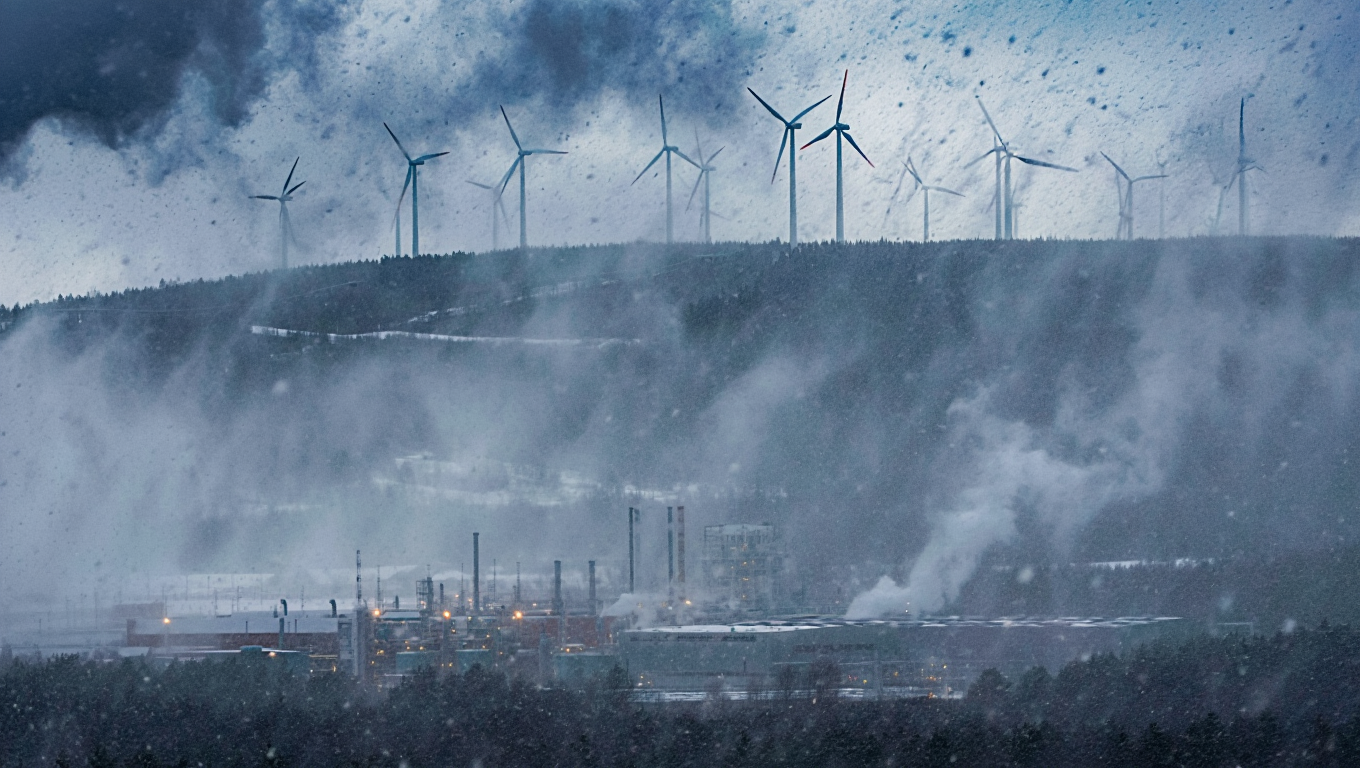
Storm Kristin caused the shutdown of 5,000 MW of wind generation due to winds exceeding 90 km/h.
-
Red Eléctrica activated the SRAD and shut down 1,725 MW of industrial load for two hours.
-
20 combined-cycle plants were not synchronized and were unable to respond in time to the imbalance.
-
There was no excess of renewable electricity, but rather an excess of wind that forced wind turbines to shut down for safety reasons.
-
Industry once again acted as a buffer for a system that needs more backup and flexibility.
January 30, 2025
On the morning of January 28, between 8:00 and 10:00 a.m., Red Eléctrica activated the Active Demand Response Service (SRAD) and temporarily disconnected 80 large industrial consumers participating in this mechanism. The cause was a sudden mismatch between generation and demand triggered by Storm Kristin, which led to the automatic shutdown of thousands of megawatts of wind power, a drop in imports from Portugal, and the immediate unavailability of sufficient thermal reserves.
The episode has once again highlighted an uncomfortable reality: Spanish industry continues to act as the fuse of the electricity system, the first to be disconnected whenever something fails in the supply–demand equation.
What exactly happened?
Some headlines spoke of an “excess of wind generation.” However, what occurred was exactly the opposite. There was no excess of renewable electricity, but rather an excess of wind that forced wind turbines to shut down for safety reasons, causing a sharp drop in wind generation. The difference is not trivial: how we interpret it shapes our understanding of system risks and the solutions we put forward.
According to available data, forecasts pointed to wind production above 11,000–12,500 MW. Reality was very different: actual generation fell to around 7,500 MW in the middle of the morning, with wind gusts exceeding 90 km/h—and even reaching 130 km/h in some areas—triggering the automatic shutdown mechanisms of wind farms. This shortfall was compounded by a significant reduction in imports from Portugal, which was also affected by the storm.
The result was an imbalance of around 2 GW between generation and demand at a critical time of day. Although the system had combined-cycle plants available, many of them were not synchronized or held in operating reserve, which limited their ability to respond immediately. Faced with this scenario, the system operator activated the SRAD, a mechanism designed precisely for such situations, and it operated without incident.
From a technical standpoint, the system responded. From a strategic standpoint, the episode raises several warning signs that should not be ignored. From the Industry and Energy Forum, we must ask: what does this episode tell us about the Spanish electricity system? Are we normalizing the idea that industry should be the default fuse whenever there is an imbalance?
Lessons from this episode
Diversification of the energy mix is non-negotiable. The energy transition cannot rely exclusively on renewables without sufficient backup. When 5,000 MW of wind power disappear within minutes, the system must be able to respond immediately. Wind power did not fail; it operated in accordance with safety protocols. But this episode shows how closely the transition is tied to the ability to anticipate deviations, manage rapid ramps, and have flexible resources that can be activated with very little lead time.
Thermal reserves must be available. The fact that 8,000 MW of combined-cycle capacity were not ready to come online reveals a planning problem. If thermal generation is expected to respond in emergencies, it must be ready. This episode showed that having theoretical capacity is not the same as having operational capacity available when it is needed. The existence of up to 20 combined-cycle plants not synchronized and unable to react in time underscores the need to review scheduling and reserve criteria.
Storage and flexible management are urgent. This episode reinforces the need for more batteries, pumped hydro storage, and intelligent demand management. These must stop being pilot projects and become critical infrastructure. Flexibility is not just about generation; it also includes interconnections and a grid capable of absorbing and redistributing energy. Without them, the risk is not a major blackout, but a succession of small incidents that, cumulatively, erode the predictability industry needs to invest, electrify, and compete.
Industry cannot be the structural adjustment mechanism. The SRAD is useful, but it cannot become the routine solution for covering planning shortcomings. Industry needs predictability to invest and electrify. If every imbalance is resolved by disconnecting factories, reindustrialization becomes more difficult. Once again, industry was the first to be shut down to compensate for an imbalance it did not cause. The SRAD is a valuable and voluntary instrument, and its activation was appropriate. But normalizing a situation in which industrial competitiveness depends on occasional shutdowns—even if they are remunerated—raises fundamental questions about the transition model and how adjustment costs are distributed.
Interconnections are not always the escape valve. When Portugal suffers the same problem due to the same storm, interconnections do not help. Spain needs sufficient internal backup capacity.
Finally, this event also offers a lesson for public debate. Talking about an “excess of generation” when the real issue is a deficit caused by extreme conditions can distort public perception of the energy transition. This is not a problem of “too many renewables,” but of the need to accompany their deployment with system management capable of handling its growing complexity.
Let’s not normalize the exceptional
In 2025 there had been no SRAD activations until now; this was the first of the year. The risk is normalizing these episodes, assuming that “this is how the energy transition works” and that industry must get used to shutting down whenever the system requires it.
The energy transition must be built on a robust, diversified system with sufficient backup, and with industry as an active protagonist—not as an emergency fuse. The January 28 episode is a warning: not about the viability of renewables, but about the urgent need for a more flexible system, with more storage, well-planned thermal reserves, and a vision that places industry at the center of the transition.