

Published in El Economista
-
Hormuz has not created our industry’s competitiveness problems; it has intensified them and, above all, made them visible.
-
The question we have been asking ourselves incorrectly for months is not whether we want gas or renewables, but what role gas should play in an increasingly renewable system.
-
Putting forward a solid and predictable backup technology does not mean renouncing decarbonisation; it means giving it a life insurance policy.
-
This is not about choosing between decarbonisation and energy security. It is about designing the latter to make the former possible.
-
Sometimes, correcting course in time and reordering priorities is not a sign of weakness, but of strategic intelligence.
9 October 2026
There are moments when a crisis explains far more than the crisis itself. The rise in gas prices we are currently experiencing is one of them.
For weeks, we have been pointing to Ormuz. The Strait has become the perfect villain: distant, geopolitical, and unrelated to our own decisions. The geopolitical tension in the region has contributed to straining a European market entering autumn with lower-than-usual gas reserves, and Spanish industry is once again doing the maths: business associations estimate that the combined rise in gas and electricity prices could add €7.4 billion to its energy bill by the end of the year, with 70% of that extra cost concentrated in the final four months.
But blaming international instability alone is a diagnostic error. Ormuz has not created our industry’s competitiveness problems; it has intensified them and, above all, made them visible. What we are experiencing does not originate in the Strait: it stems from an energy model that had long been showing its cracks.
The tree of the transition and the forest we fail to see
For years, we have learned to think about the energy transition in terms of arrival: 2030, 2050, the major milestones on the green pathway. And that horizon is right; nobody disputes the goal. But an industry does not produce in 2050. It produces today. And tomorrow, too.
Industrial competitiveness is at stake in contracts being signed now, in bills arriving now, and in production and investment decisions that cannot wait until every piece of the new energy system is in place. When the steel sector calculates an additional cost of €658 million for 2026 and has already begun halting production during the most expensive hours, the long term is no longer a valid excuse for ignoring the short term. The transition is not won only by reaching the final goal; it is also won by surviving every winter that must be endured along the way. And right now, with European gas reserves at around 65% of capacity —well below the average of the past fifteen years—, that winter looks demanding.
An energy transition should not mean keeping a roadmap intact while the world around it changes.
Back to square one
Perhaps the time has come to go back, if only for a moment, to square one. Not to question the destination of the energy transition —nobody is doing that, nor should they—, but to ask ourselves what we really need in order to get there.
Because the question we have been asking ourselves incorrectly for months is not whether we want gas or renewables. The question should be different: what role should gas play in an increasingly renewable system? And that question becomes urgent when we see that the price of Spanish electricity futures for 2027 has already risen by 78% since January. That cannot be fixed with more patience; it requires decisions, and sometimes the smartest decision is not to insist on the same design, but to correct course before the problem becomes embedded in the contracts we are signing today.
The role we have denied gas
This is where the great taboo lies: the real role of natural gas in the energy transition. In the official narrative, any revaluation of gas is often interpreted as a step backwards on the green pathway. Nothing could be further from the truth. Putting forward a solid and predictable backup technology does not mean renouncing decarbonisation; it means giving it a life insurance policy.
Natural gas remains a fossil fuel, and its emissions are not compatible with the ultimate goal of decarbonisation; nothing here seeks to disguise it as something it is not. But that does not prevent us from recognising a reality of the system: compared with other non-renewable backup technologies, gas has a lower lifecycle greenhouse-gas emissions intensity and notable operational flexibility to cover thermal gaps when solar or wind output is insufficient. Its value at this stage, therefore, lies not in being the destination, but in serving as backup.
Perhaps the time has come to rethink the role of gas: not as an alternative to the energy transition, but as a supporting technology within it, subject to clear limits and intended to lose prominence as alternatives mature. A bridge, if we want to use that word, but one designed with a clear principle: the further the transition advances, the less necessary it should become. This is not about choosing between decarbonisation and energy security. It is about designing the latter to make the former possible.
Living with the problem, without resigning ourselves to it
None of this can be solved tomorrow. Accepting that we will have to live with this energy source for some time requires, precisely for that reason, giving it an appropriate and temporary role, and demanding concrete measures while it lasts: reviewing grid tariffs, bringing forward price-containment mechanisms, and providing certainty for an industry that accounts for 60% of Spain’s gross industrial output.
Living with the problem is not the same as resigning ourselves to it. The former requires decisions; the latter simply means waiting for the next Ormuz.
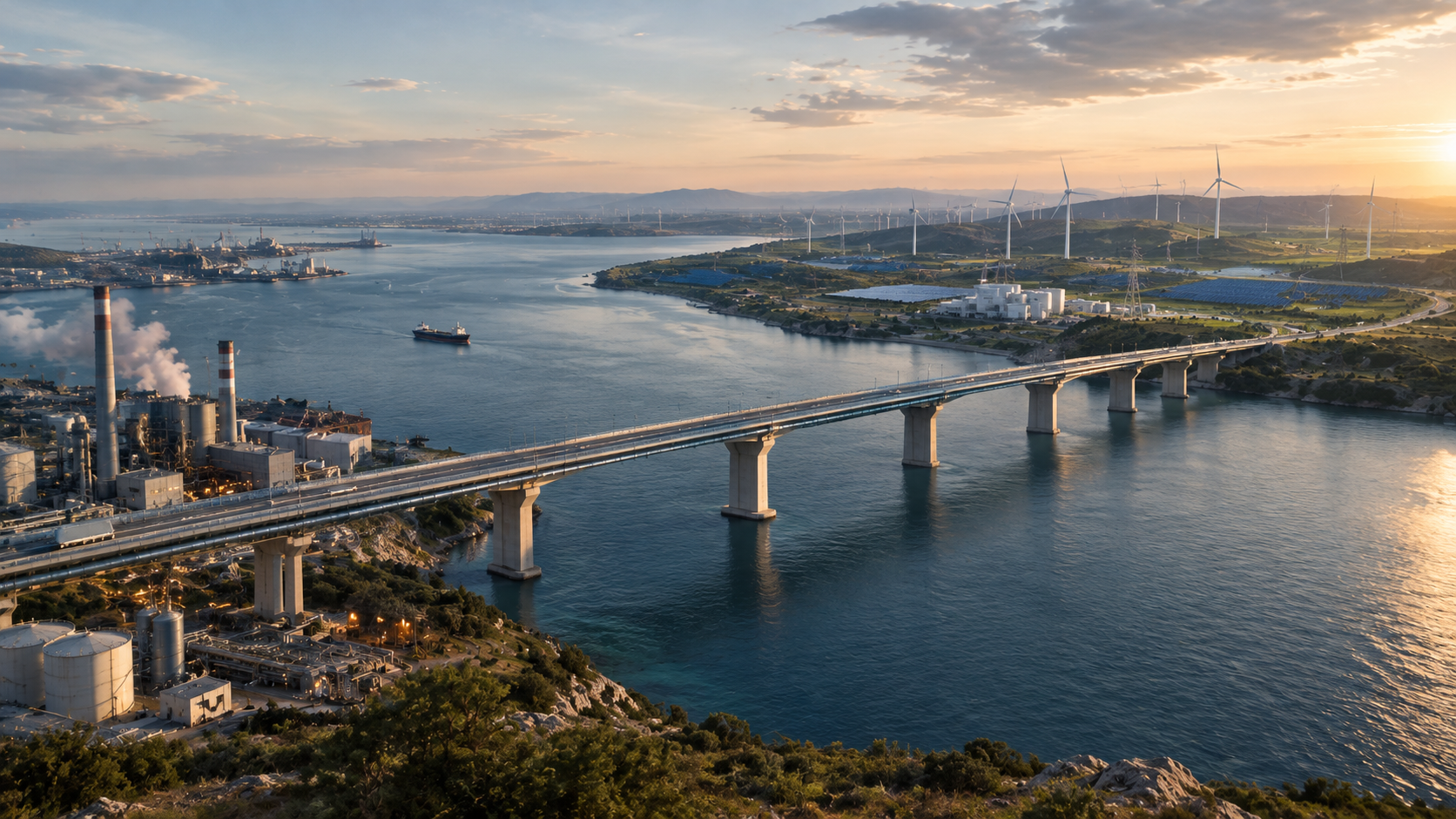
Sometimes, correcting course in time and reordering priorities is not a sign of weakness, but of strategic intelligence. If we want industry to remain the engine of our economy, we must ensure that the bridge to the future does not collapse under the weight of the present.