

-
In five months, Andalusia has lost 921 MW of available electrical capacity: more than it currently has across its entire grid (630 MW).
-
Andalusia has lost 59% of its available electrical capacity since October 2025.
-
Almería, Granada, Jaén and Málaga: four provinces with no available electrical capacity for new projects.
-
94.8% of Andalusian substations no longer have capacity: only 45 out of 950 retain any connection margin.
-
At this rate, Andalusia is approaching the point where the electrical grid will become a limiting factor for any new industrial project.
March 20, 2026.
The latest analysis of the access capacity map prepared by the Industry and Energy Forum (FIE) and Opina 360, with data as of March 1, 2026, places Andalusia as one of the autonomous communities with the greatest deterioration of its electrical grid in recent months. The region has lost 59.4% of its available capacity since October 2025, when the systematic publication of these data by distributors began, up to the March update.
Source: Industry and Energy Forum (FIE) and Opina 360
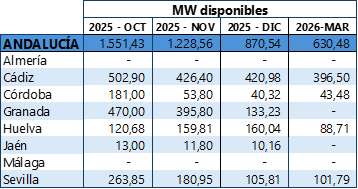
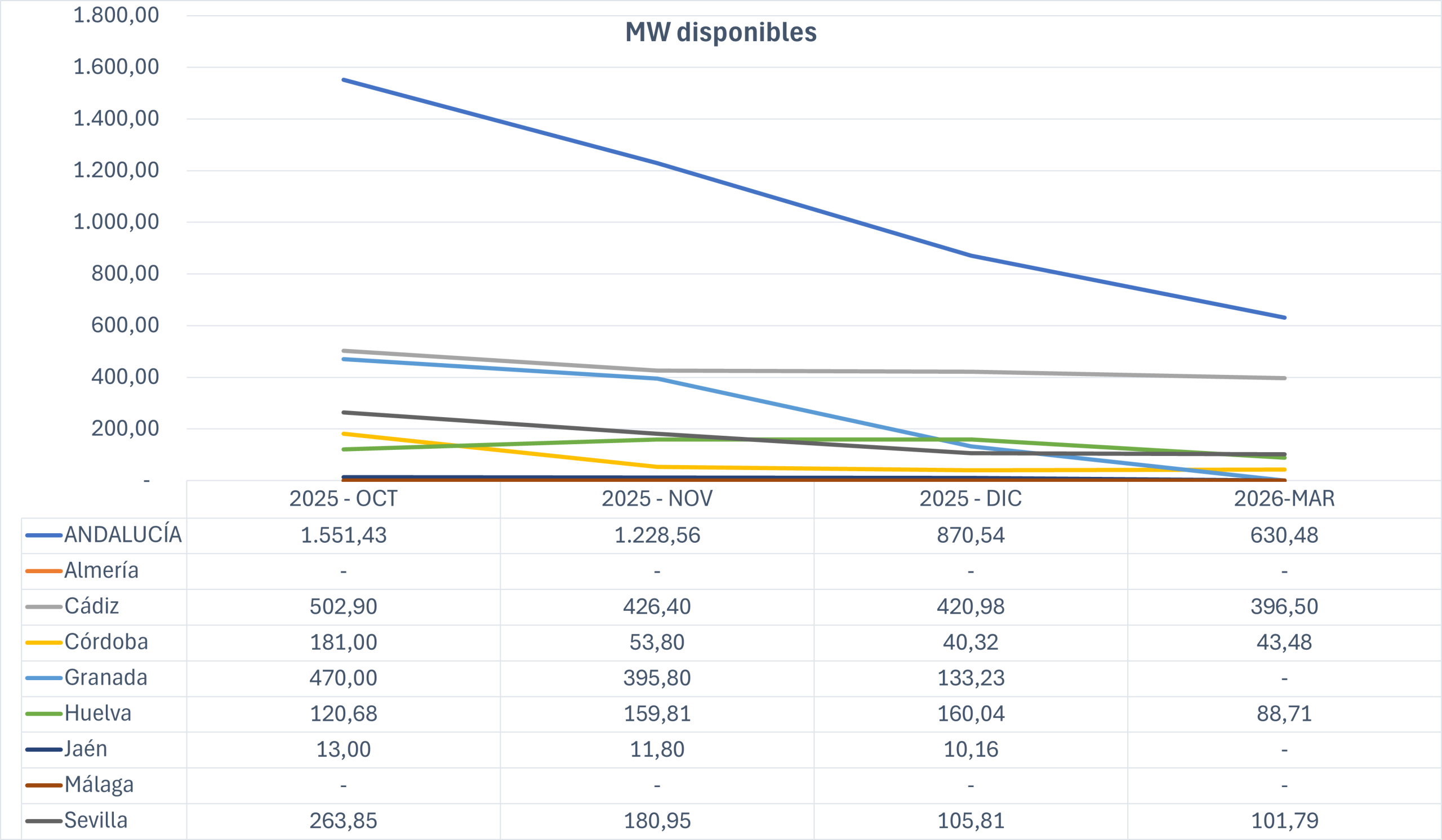
In five months, Andalusia has lost more electrical capacity than it currently has available. In absolute terms, the drop is striking: Andalusia had 1,551.43 MW available in October, a figure that fell to 1,228.56 MW in November, to 870.54 MW in December, and to 630.48 MW in March. In total, the Andalusian grid has lost around 921 MW of available capacity in just five months, a reduction unmatched across the country when considering the full period. If the current pace continues, the grid could run out of margin in the coming months. “The electrical connection infrastructure is not growing at the pace the industry needs,” warns Isabel Núñez Rotta, director of the FIE. “And that has direct consequences for the ability to attract industrial investment.”
Source: Industry and Energy Forum (FIE) and Opina 360
The third-largest deterioration since December
Compared to the latest available update — that of December 2026 — Andalusia records an additional loss of approximately 240 MW, making it the third region that has lost the most capacity in that interval, behind only Extremadura (−361 MW) and Galicia (−281 MW).
The level of saturation of its substations also reflects this trend: from October, when 89.5% of substations already lacked capacity, to the 94.8% recorded in March, saturation has increased by nearly five percentage points. At the same time, the number of substations with any available margin has been halved: from 90 in October to 45 in the March update.
Four provinces with no margin
The territorial analysis reveals that pressure on the grid is not evenly distributed. Almería, Granada, Jaén and Málaga are already fully saturated, with no available capacity in any of their substations. Four of Andalusia’s eight provinces have, in practice, closed electrical access to new projects.
A trend with direct industrial implications
Beyond the technical data, the evolution observed in Andalusia raises a fundamental issue for the region’s industrial development. If the current pace of capacity loss continues, the electrical grid could become a limiting factor for the location of new industrial projects, particularly those with high energy demand.
The availability of grid connection has shifted from being a technical variable to becoming a prerequisite for industrial investment. In this context, the data from Andalusia clearly illustrate the extent to which saturation of electrical infrastructure may shape the geography of productive activity in the coming years.