

-
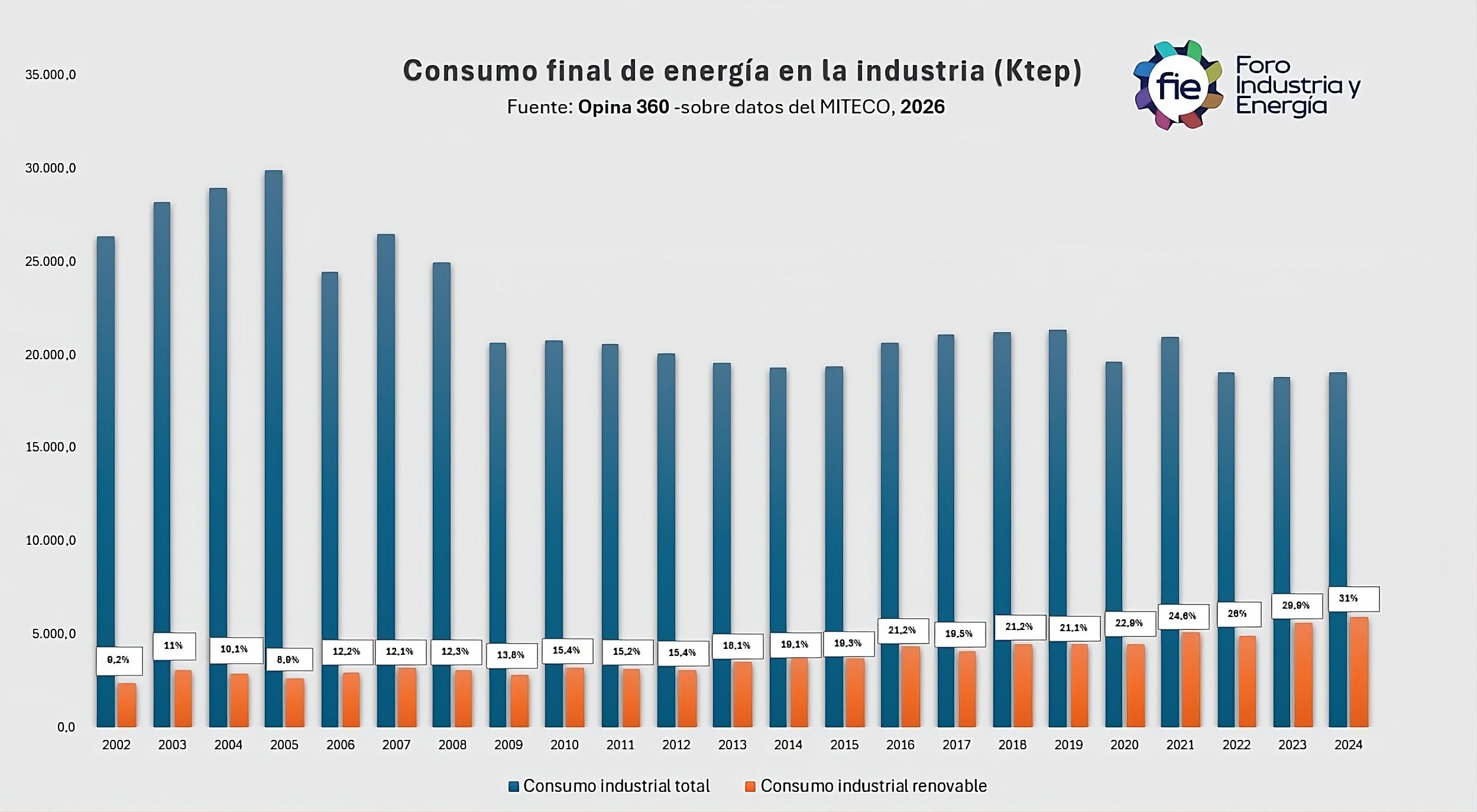
31% of energy consumed by Spanish industry comes from renewable sources.
-
2024 marks a historic record in the share of renewable energy consumed by Spanish industry, although progress is mainly driven by changes in electricity generation mix rather than by direct solutions implemented by the sector.
-
Total energy consumption by industry increased by 1.5% compared to 2023, reaching 19 million tonnes of oil equivalent (Mtoe).
-
Electricity consumption remains stagnant at 30.7% of industrial energy mix, highlighting lack of progress in sector electrification.
-
“2024 can be considered a lost year for industry decarbonisation”, Albert Concepción, president of FIE.
9 January 2026
Year 2024 has brought a new historic record in share of renewable energy consumed by Spanish industry: 31% of energy used by industrial sector already comes from renewable sources, according to analysis carried out by Opina 360 and Foro Industria y Energía (FIE) based on data from MITECO. However, behind this seemingly positive figure lies a worrying reality: Spanish industry is not actively advancing its own decarbonisation.
Progress that is not what it seems
Increase of 1.1 percentage points compared to 2023 data could be interpreted as good news. And it would be, if this increase were driven by strategic decisions taken by industrial sector itself. Reality, however, is quite different: improvement in renewable share does not come from greater direct consumption of renewable energy by industry, but exclusively from higher contribution of renewable sources to electricity generation.
Data are clear. While share of renewable energy has grown to 31%, direct consumption of renewables and waste by industry has fallen by 2.9%. At same time, natural gas consumption has increased by 4.2% compared to previous year. Total energy consumption by industry rose by 1.5% compared to 2023, reaching 19 million tonnes of oil equivalent (Mtoe), similar to 2022 levels and representing a recovery from historic low recorded in 2023 (18.5 Mtoe). However, this recovery in consumption has not translated into a transformation of industrial energy model.
Electrification that never arrives
For Juan Francisco Caro, director of Opina 360, “the fact that electricity remains stuck at 30.7% of industrial energy mix is highly relevant, because it indicates that no substantial progress is being made in electrification of industrial processes”.
This stagnation shows that Spanish industry is not advancing in electrification of its processes, one of fundamental pathways for decarbonisation. There are industrial processes that are difficult to electrify, it is true, but even in sectors where electrification is technically viable, no significant progress is being made.
PNIEC targets: increasingly distant
Energy consumption figures for industry in 2024 force serious reflection on whether targets set in National Integrated Energy and Climate Plan (PNIEC) are achievable under current trajectory. PNIEC aims to reach 81% renewable electricity generation, covering 48% of final energy consumption, reduce emissions by 32% compared to 1990 and improve energy efficiency by 43%.
With an increase of just 1.1 percentage points in renewable penetration in industry during 2024, and no progress at all in electrification, it is difficult to imagine how these targets can be met within established timelines. This is not only a technical problem; administrative obstacles and regulatory uncertainty are playing a decisive role in this paralysis.
As explained by Albert Concepción, president of Foro Industria y Energía, during event “Keys to security of supply in Catalonia: electricity grids and nuclear energy” organised by Foment del Treball, constant uncertainty hanging over industry has led some large companies to renounce PERTE funds despite having made significant progress in electrification processes in industries where this transformation is particularly complex.
Need for a realistic picture
It is precisely in situations like this that initiatives such as Foro Industria y Energía become essential. This is not about adopting a critical stance for its own sake, but about providing rigorous analysis that allows real problems to be identified and effective solutions to be sought. To advance in industry decarbonisation, we need to start from an accurate picture of situation, without statistical mirages or complacency.
Albert Concepción, president of Foro Industria y Energía, believes these data reflect a “worrying paralysis” in active energy management of industry: “Spanish industry is allowing others to manage its energy transition instead of being an active protagonist of its own decarbonisation. It depends entirely on electricity mix and on an electrification process that is not progressing as fast as expected. 2024 can be considered a lost year for industry decarbonisation”.
According to Isabel Núñez Rotta, head of institutional area at FIE and director of analysis, “this study aims to provide a realistic picture of origin of energy consumed by Spanish industry, and it should not be forgotten that not all electricity consumed by industry comes from renewable sources and that natural gas, for example, has a very significant share in electricity mix”.
Data from 2024 offer two main conclusions that cannot be ignored. First: path towards renewables in industry is stalled and exclusively conditioned by external factors, mainly evolution of electricity mix. Second: electrification of industrial processes, one of key levers for decarbonisation, is simply not progressing.
A lost year
If an honest assessment of 2024 in terms of industrial decarbonisation is required, conclusion is clear: it has been a lost year. Record of 31% renewable energy is a favourable statistical figure, but it does not reflect any real progress in industry energy management. No proprietary solutions have been implemented, no progress has been made in electrification, and consumption of fossil fuels such as natural gas has increased.
Spanish industry needs to take centre stage in its own energy transition. But none of this will be possible without a stable regulatory framework that provides certainty for investments and without streamlining administrative processes that are currently weighing down even companies most committed to decarbonisation.
Numbers do not lie: at this pace, PNIEC targets will remain far from being met. It is time to move beyond statistical mirages and face reality: without a significant change of course, industrial decarbonisation will continue to be an unresolved challenge.