

J.R. Morante and H. Santcovsky
September 25, 2026
For decades we have spoken of productivity as a relationship between labor, capital, technology, and organization. Artificial intelligence now compels us to add—once again, and with far greater force than seemed likely just a few years ago—an element that never disappeared but that the digital economy managed to partially conceal: energy.
The promise is familiar. Artificial intelligence will enable us to do more in less time, automate tasks, improve processes, reduce costs, and free up human capacity for higher value-added activities. In short, increase productivity. But there is a prior question we are only just beginning to uncover: with what energy?
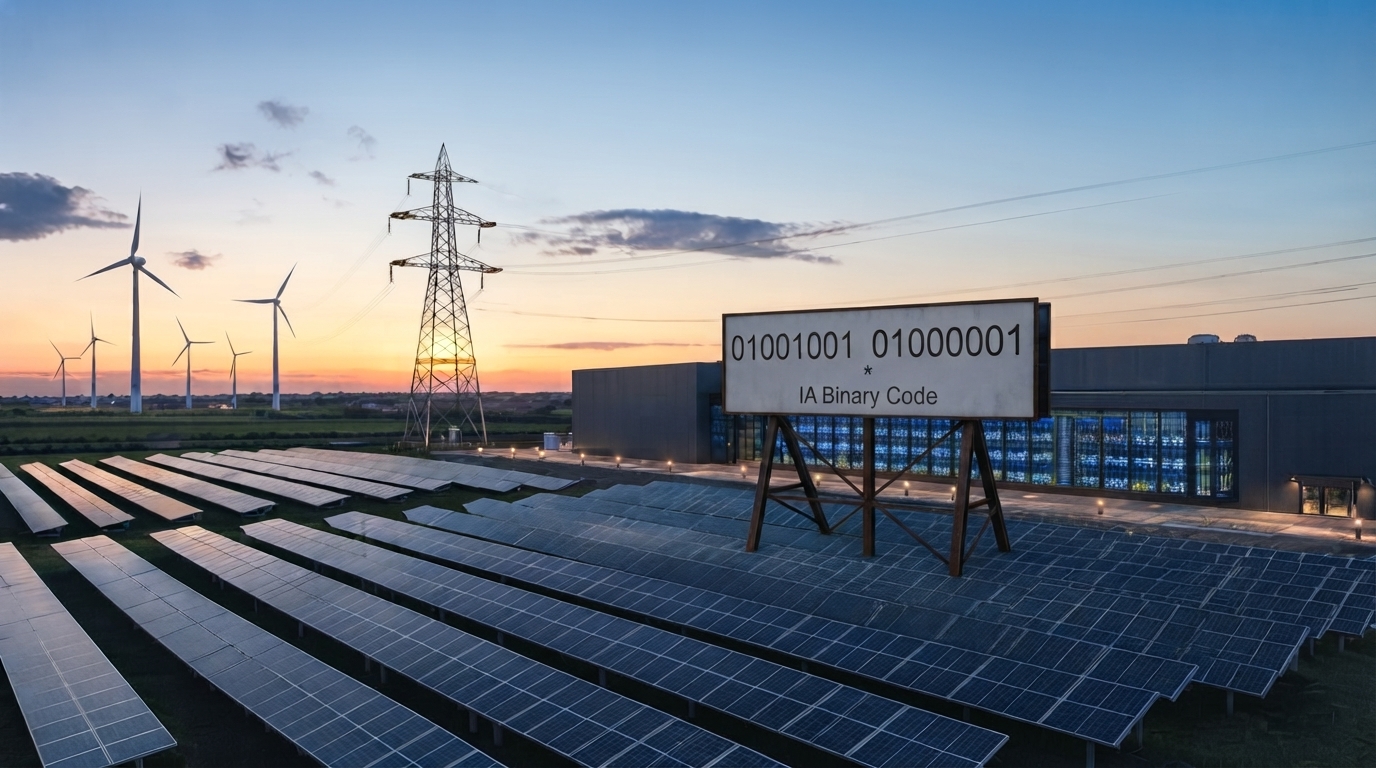
The cloud was never in the cloud. Behind every search, every AI model, and every automated process lie data centers, semiconductors, cooling systems, power grids, and enormous investments. The seemingly most immaterial economy we have built is rapidly discovering its material constraints. And that changes the conversation about productivity.
The scale of this shift can already be measured. The International Energy Agency forecasts that global electricity consumption by data centers will grow to 945 TWh per year by 2030, up from 415 TWh in 2024, and for 2026 alone Gartner estimates that this consumption will reach 565 TWh, with servers optimized for artificial intelligence.
It will no longer suffice to measure how many hours of work an AI system can save. We must also ask how much energy it needs to do so, what infrastructure it requires, the source of that energy, and what economic and social value is generated by the energy consumed.
The relevant question may cease to be simply how much productivity increases per worker and become also how much productivity we obtain per additional unit of energy. This is where an uncomfortable debate begins.
Not all uses of artificial intelligence generate the same value. Using enormous computing capacity to improve industrial processes, develop new materials, optimize power grids, accelerate scientific research, or enhance certain public services does not necessarily yield the same economic and social return as generating unlimited quantities of low-value content.
Yet all of them compete for physical resources: electricity, grid capacity, data centers, chips, water, land, capital, and location. This is why energy is reasserting itself in industrial policy.
The scale of investment required is staggering: capital expenditure by the five largest tech companies exceeded $400 billion in 2025, with a forecast growth of another 75% in 2026, while the capacity of so-called “AI factories” has more than tripled in just 18 months.
An economy may have excellent universities, researchers, tech companies, and sufficient capital, and at the same time find that a new factory, a data center, or the electrification of an industry cannot proceed because there is no available power, because an electrical node is saturated, or because a connection will take years to build.
This is no longer hypothetical: in Ireland, around 21% of national electricity is already devoted to data centers, with projections of up to 32% by 2026, a case that foreshadows what other European power grids will begin to experience.
At that point, the energy problem ceases to be solely an energy problem. It reasserts itself as a problem of productivity, competitiveness, and investment.
Artificial intelligence can make this contradiction even more visible. Europe wants simultaneously to digitalize its economy, reindustrialize, decarbonize, electrify mobility, and develop its own artificial intelligence. All these strategies have one thing in common: they need sustainable energy.
To gauge the challenge: the IEA calculates that data centers will account for around 3% of global electricity consumption by 2030, a percentage equivalent to all the electricity Japan consumes in a year.
That is why discussing artificial intelligence without discussing energy is beginning to seem as insufficient as discussing the energy transition while talking only about renewable generation and forgetting about grids and storage. But there remains an even more important issue.
Productivity growth is never exclusively a technological problem. It is also a distributive problem. A society can produce much more per hour worked without that milestone necessarily translating into better wages, shorter working hours, better public services, or greater well-being.
If artificial intelligence dramatically increases productivity, but the benefits of that transformation remain concentrated in the hands of those who control the algorithms, the data centers, the infrastructure, and the energy needed to power them, we will have an economy that is technically more efficient but possibly a more unequal society.
The question, therefore, is not only about achieving ever more powerful artificial intelligence. It is about deciding what we want to use that power for, what resources we are willing to devote to it, and how we will distribute the benefits of the additional productivity it generates. There lies one of the great economic and political debates of the coming years.
For a long time we thought the digital economy would allow us to produce more while using ever fewer material resources. Artificial intelligence is demonstrating something quite different: even the knowledge economy needs factories, grids, raw materials, and enormous quantities of electricity. Intelligence may be artificial. Sustainable energy, for now, is not.