

J.R. Morante and H. Santcovsky
4 September 2026
Talking about industry and energy also means talking about transport. Industrial activity does not end at the factory gate: raw materials, components, finished products and people must move for production and distribution chains to function. Mobility is therefore an essential part of the productive system and its competitiveness.
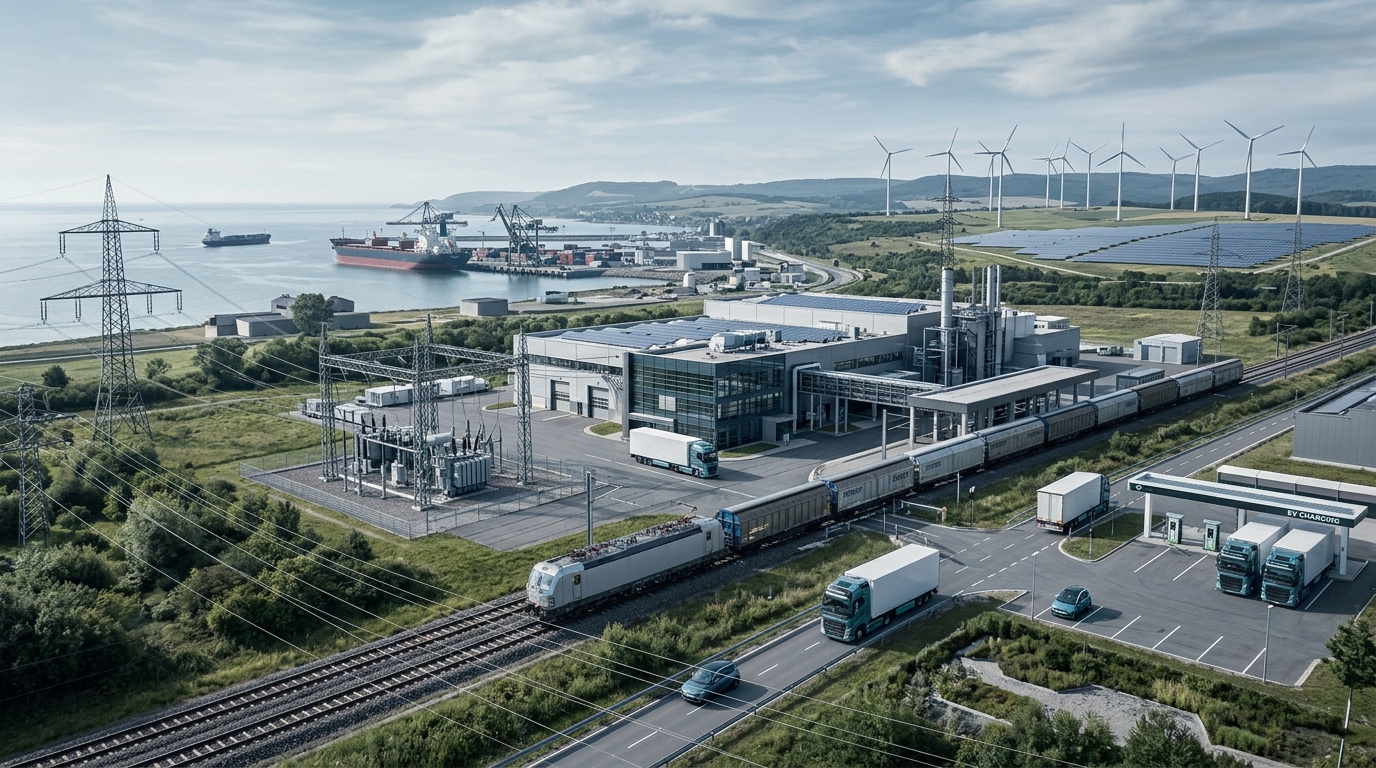
For this reason, the decarbonisation of transport cannot be analysed in isolation from industrial and energy policy. Replacing fossil fuels means shifting a substantial share of energy demand from oil to the electricity system, with direct consequences for power generation, transmission and distribution networks and the required investments, which in turn calls for a new energy infrastructure serving the productive economy.
When we speak of carbon budgets or sustainability, many assume these are issues distant from everyday life. But they are not. Decarbonisation means changing how we move, produce and consume energy. Self-sufficiency, electrification and emissions reduction are one and the same strategy. And it is in road transport that this lack of planning is most evident.
Decarbonising road transport is the central objective of the energy transition. Yet public debate focuses on vehicles and options, not on the energy planning and infrastructures required.
Spain has more than 165,000 km of roads. There are 12,685 service stations, dispensing 29 Mt of fuel per year (76% diesel), equivalent to a consumption of 32,000 million litres, or around 320 TWh. Each fossil litre emits 3–3.2 kg of CO₂; therefore, meeting carbon budgets implies a reduction of 100 Mt by 2050.
Battery electrification enables energy savings of 250% compared with internal combustion, but requires clean energy, a robust electricity grid and charging infrastructure. This is not the case for hydrogen, synthetic fuels or biofuels, whose energy balance is far inferior. Current consumption of 320 TWh would fall to 128 TWh of electricity; for example, in Catalonia, to 26 TWh, which would require an increase in electrical capacity of more than 3 GW (equivalent to Catalonia’s nuclear plants).
The European AFIR regulation requires, by 2027, charging hubs every 60 km (light vehicles) and 120 km (heavy vehicles), with minimum powers of 150 kW and 350 kW per charger. On the state and regional networks alone, more than 26,000 chargers would be needed; adding provincial and local networks, a further 1,100 additional hubs on provincial roads.
There are currently 56,181 public charging points, but two-thirds are low-power (obsolete) and the rest do not reach 250 kW; moreover, 25% are out of service. Private deployment is also predominantly low-power. The figure is misleading: most do not meet European requirements. We must move from 12,685 service stations to a new system of charging stations adapted to demand and technology.
Next-generation batteries require powers well above 150 kW for charging in under 10 minutes. Electric trucks with 720 kWh batteries require charging in 45 minutes (mandatory rest), demanding more than 1 MW per charger. With 4 light and 2 heavy chargers, 3 MW per charging hub may be insufficient at peak times. This implies many GW, >36 GW.
The PNIEC 2023–2030 foresees 27.7 GW of new industrial demand, but does not explicitly address the needs of electric transport. The electricity grid, already saturated, must be urgently adapted, and the challenge is not only to install chargers, but to ensure simultaneous power capacity. Without explicit planning, decarbonisation targets remain on paper.
Conclusion
The distribution and transmission network must urgently incorporate the needs of road electrification to meet carbon budgets. Without this, the charging infrastructure required for efficient and sustainable mobility cannot be deployed. Failing to address this delays the transition, prolongs fossil dependence and maintains less efficient solutions, often linked to interests of the internal combustion engine.
The challenge is not technological (vehicles and batteries already exist; regulation sets the course), but one of planning: substations, lines, transformers and grid capacity to power thousands of high-power points.
Furthermore, the charging station must be a public service, with regulation fixing prices beyond the speculative market. The cost difference between charging at home and on the public road is the investment in infrastructure; authorities must manage this within the transition, without leaving it to market voracity.
In short: what planning (public or private) exists for charging infrastructures? How will the electricity grid be adapted and what economic model will guarantee a competitive service? What is the roadmap to 2050? Without coherent answers, emissions targets will be mere intentions.