

-
The energy transition has been built on gigawatts and gigatonnes of CO₂. It is time to add a third metric: “gigalitres” of water.
-
According to the UN World Water Development Report by UNESCO, 49% of water consumption in Europe is used by industry.
-
Any improvement in water treatment efficiency has a direct impact on the energy bill, and vice versa: an industry that manages its energy better can also reduce its process water needs.
-
While energy raises process temperatures, water lowers them. The two are inseparable.
-
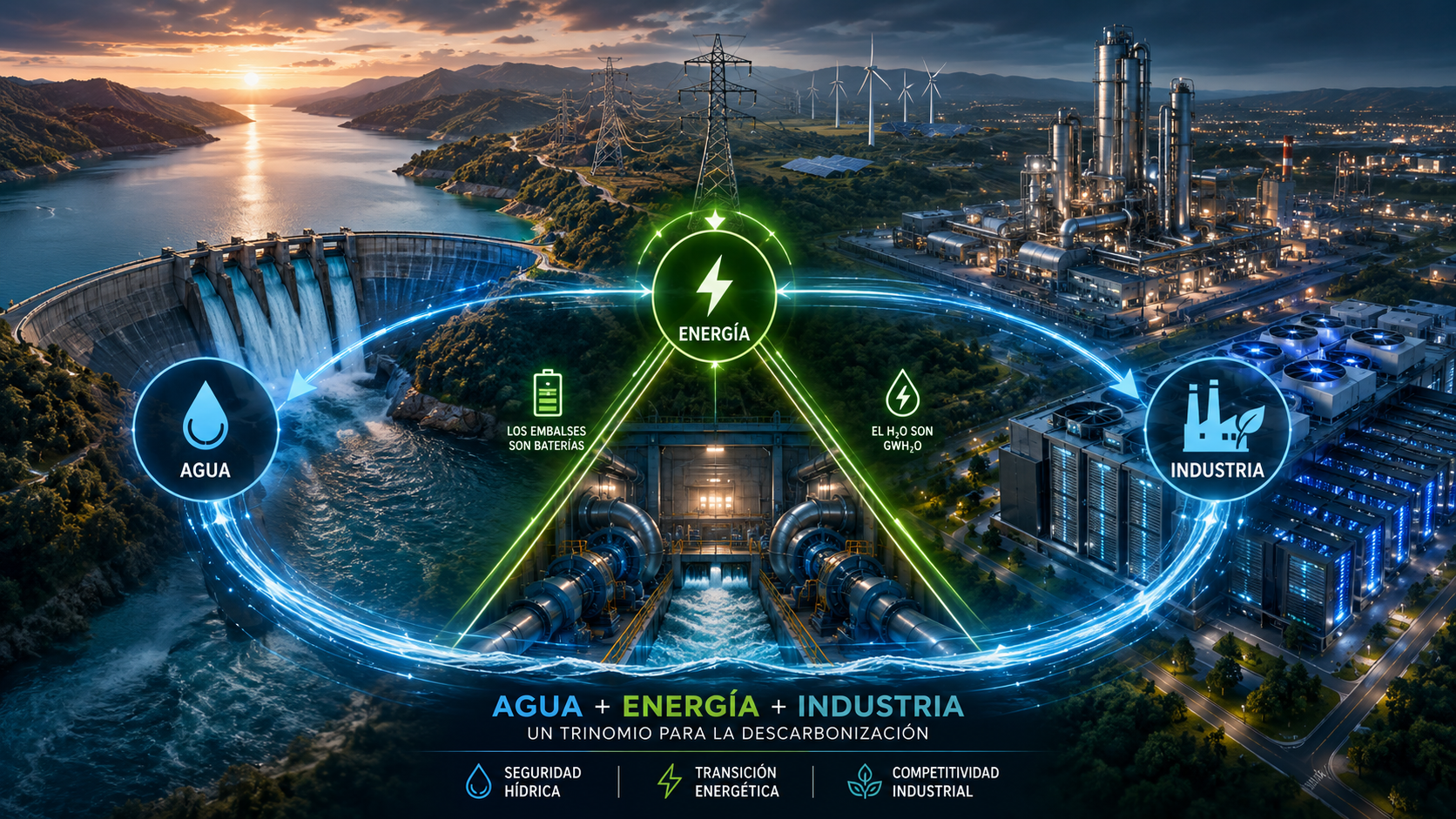
Reservoirs are not just water storage facilities. They are also batteries that store a new concept.
-
The future of decarbonization is not only green. It is also blue. And we must avoid the risk of an energy drought.
May 29, 2026.
There is no industrial company that can operate without energy. Nor is there any industrial company that can operate without water. And yet, for decades both resources have existed in separate compartments: different regulations, different indicators, different strategies. Today, in the midst of the energy transition, that separation is beginning to show its limits.
The reservoir as a battery: from H₂O to GWh₂O
The World Economic Forum (WEF) has just published a report that states it plainly: water is the hidden currency of the energy transition, embedded in every kilowatt generated, every battery produced, and every data center cooled.
A strong example can be found at home. The Cortes-La Muela hydroelectric complex, in the Júcar basin (Valencia), is the largest pumped-storage power plant in Europe. With more than 1,700 MW of installed capacity and 24 GWh of storage, it is not just a power station: it is a gigabattery. When there is surplus renewable energy in the grid—say the wind is blowing hard at three in the morning—that energy is not wasted; it is used to pump water from the lower reservoir to the upper one. When demand rises, the water flows down, turbines spin, and electricity is generated. When the grid has excess, water goes up. When demand tightens, water comes down and electricity flows.
In other words: reservoirs are not just water storage facilities. They are batteries. H₂O is also GWh₂O.
This plant demonstrated its strategic value on April 28, when it was one of the first infrastructures to feed electricity back into the grid during the major blackout that hit the Iberian Peninsula. Its black-start capability—operating without external power—makes it a critical resilience asset.
The 49%: industry and the water we do not see on the bill
If energy is metered, industrial water often is not. And yet the data are clear. According to the UN World Water Development Report by UNESCO, 49% of water consumption in Europe is used by industry. Globally, 19% of freshwater withdrawals are used jointly for industry and energy generation.
The food industry may be the clearest example: it produces what we eat, but requires vast amounts of water at every stage of the process. The chemical, steel, pharmaceutical, and textile industries all rely on water as an invisible input.
And there is one use that has rapidly moved up the agenda: data centers. Every search, every AI query, every streamed video generates heat that must be dissipated. In most cases, that heat is managed with water. While energy raises process temperatures, water lowers them. The two are inseparable.
Treating water also requires energy
The relationship is not one-way. If water is necessary to generate energy, energy is essential to treat water. Drinking water treatment and wastewater treatment account for up to 5.4% of global electricity demand, according to recent estimates. In many municipalities and industrial parks, it is one of the largest energy expenditures—and paradoxically, one of the least optimized.
This means that any improvement in water treatment efficiency has a direct impact on the energy bill, and vice versa: an industry that manages its energy better can also reduce its process water needs.
The risk of energy drought
When discussing climate risks for industry, people tend to think of extreme weather events or rising CO₂ prices. Rarely is drought considered an immediate operational risk. It should be.
Factories and power plants have historically been among the largest water consumers on the planet, particularly for cooling. When severe drought hits, these facilities become vulnerable, and supply chains can grind to a halt, as noted by the WEF in its recent report on water and decarbonization. This is not a hypothetical scenario: it has already happened in Europe, where thermal power plants have had to reduce output due to excessively high river temperatures.
The shift to renewables is not only a climate decision. It is also a water risk management decision: wind and solar consume far less water than any thermal generation technology.
Integrated management: the missing piece
The solution exists and has a name: integrated water and energy management. Improving energy efficiency reduces water demand, and vice versa. They are communicating vessels that have been managed independently for too long.
Industries with strategic vision are already taking action: closed-loop cooling systems, wastewater reuse, process optimization through artificial intelligence. According to the WEF, water efficiency technologies could save tens of billions of cubic meters of water annually worldwide, while simultaneously reducing the energy use and carbon emissions associated with pumping, heating, treating, and transporting that water.
However, the main obstacle is not technological but organizational. Water and energy have long existed in separate regulatory and corporate silos. The opportunity lies in breaking down those silos, aligning incentives, and measuring both resources together.
One metric is not enough
The energy transition has been built on gigawatts and gigatonnes of CO₂. It is time to add a third metric: “gigalitres of water.” Not because water is more important than energy, but because they are inseparable. Ignoring one side of the trilemma means underestimating the real costs of decarbonization and, above all, the operational risks that are already knocking at industry’s door.
The future of decarbonization is not only green. It is also blue. And our challenge must be to avoid energy drought as well.