

-
The latest analysis by the Industry and Energy Forum (FIE) and Opina 360 reveals that 5,265 (86.3%) substations already lack available capacity, 30 more than last December.
-
The grid has 7,400 MW available, far from the more than 10 GW recorded in October 2025.
-
Despite a slight net recovery in power, the grid has lost 1,226.4 MW in strategic nodes, consolidating a trend of structural saturation.
-
In ten of the seventeen autonomous communities analyzed, the level of saturation increases while available megawatts decrease simultaneously.
- The CNMC confirms that substation saturation is not only an access problem, but also one of resilience.
March 20, 2026.
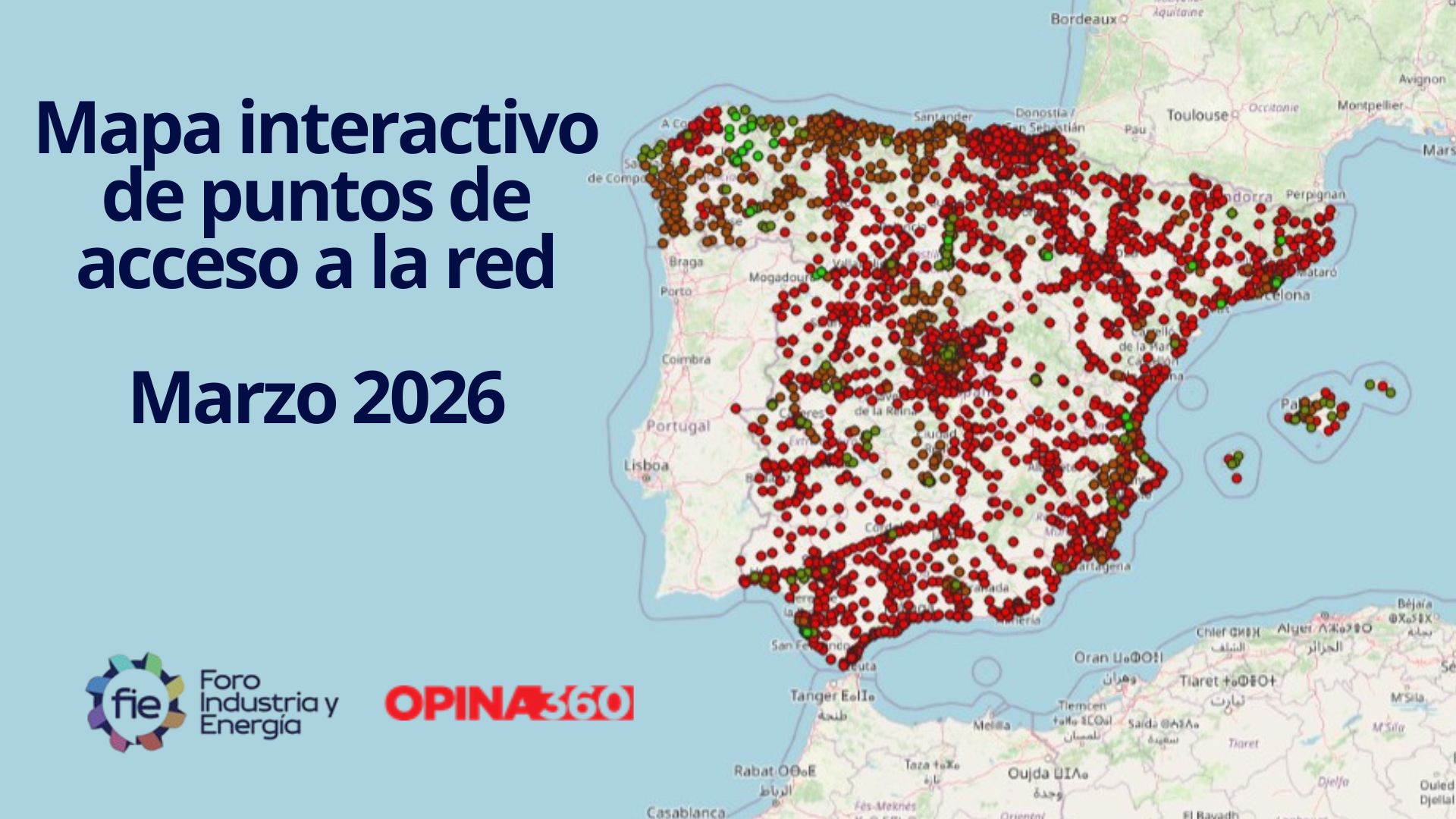
86.3% of Spanish electrical substations, that is, nine out of ten, are already fully saturated and have no available capacity, according to the latest update of the access capacity map prepared by the Industry and Energy Forum (FIE) and Opina 360. The new analysis, with data as of March 1, 2026, confirms that the Spanish electricity grid maintains a very high level of structural saturation and that connection availability continues to decline progressively.
The study analyzes 6,102 substations belonging to the 29 largest distributors in the country, which account for 97% of supply points. The results show that 5,265 substations no longer have available capacity, which is 30 more than in the December update. In percentage terms, the level of saturation rises from 85.7% to 86.3%, consolidating an upward trend that has been observed since the end of 2025.
As a result, only 837 substations (13.7%) maintain some connection margin, further reducing the number of nodes potentially available for new industrial or electrification projects.
In terms of power, the grid currently has 7,400.8 MW of available capacity, a figure practically identical to that recorded in December (7,363 MW), but far below the more than 10,000 MW that were still available in October 2025.
The stability of MW is misleading: the grid continues to lose capacity
Although the aggregate figure of available megawatts appears to have stabilized, a detailed analysis reveals a more complex dynamic.
As explained by Isabel Núñez Rotta, director of the Industry and Energy Forum, the apparent stability hides constant movement within the grid: “At first glance, the aggregate figure for March could be interpreted as stabilization: the grid had 7,363 MW in December and now has 7,401. But the granular analysis reveals another reality. In these three months, the grid has lost more than 1,200 MW in certain areas while releasing just over 1,260 in others. The net balance is barely 37 MW. That is not capacity expansion: it is substitution. And the dynamic of demand pressure on the grid is not easing; it continues to grow: there is increasingly more demand and less supply.”
Ten regions worsen simultaneously in saturation and available capacity
The territorial analysis confirms that the trend is not uniform, but it is negative across much of the country. In ten of the seventeen autonomous communities analyzed, the level of saturation increases while available megawatts decrease simultaneously, reflecting a progressive deterioration in connection margins.
Among the most significant cases is Extremadura, which loses around 361 MW of available capacity and increases its saturation from 79.7% to 83.3%. Galicia also reduces its capacity by around 281 MW and raises its saturation level to 53.5%, while Andalusia loses nearly 240 MW and reaches 94.8% saturation. In Madrid, meanwhile, the level of saturation rises from 85.1% to 90.9%, reflecting growing pressure on electricity access in one of the country’s main economic hubs.
Other regions such as Castilla-La Mancha, the Balearic Islands, Cantabria, and Asturias also register increases in their level of saturation accompanied by losses in available capacity. Overall, these data reflect a progressive deterioration in connection margins across much of the national territory.
According to Juan Francisco Caro, director of Opina 360, the data confirms it: “Grid saturation is not a one-off phenomenon, but a structural trend. Although some regions occasionally gain capacity, the number of available nodes continues to decrease and pressure on the grid keeps increasing.”
The CNMC points to the same issue
The report that the CNMC has just published on the incident of April 28, 2025 includes a particularly relevant conclusion in this context. Among the causes that contributed to system instability, the regulator points out that there is unmet demand due to lack of access capacity to the grid which, if present, would have contributed to greater voltage stability.
The implication is important: grid saturation not only prevents new projects from connecting, but its effect extends to the entire system. Less connected demand means less stability. Blocked access is not just a problem for those waiting to connect; it affects the robustness of a grid that needs that demand to function better.
The CNMC indicates that it is working on regulatory and transparency measures to address this situation, confirming that the access problem has firmly entered the regulator’s agenda.
The electricity grid consolidates as a critical factor for industrial location
Beyond the technical data, the analysis by the Industry and Energy Forum points to a clear conclusion: the availability of electrical connection is becoming one of the determining factors for industrial investment location.
As noted by Albert Concepción, president of the Industry and Energy Forum, the evolution of the grid forces a rethink of the industrial policy debate: “The trend we are observing confirms that access to the grid is becoming a prerequisite for industrial development. If we want a competitive and domestic industry, addressing the problem of grid saturation is no longer a technical issue but a strategic one.”
In this context, the interactive access capacity map developed by the Industry and Energy Forum and Opina 360 is becoming a key reference tool for companies, public administrations, and analysts who need to understand how the country’s electrical infrastructure is evolving and to what extent connection availability may shape the geography of industrial investment in the coming years.